
I’m not buying “a mirror.” I’m buying a low-return, high-repeat SKU.
I source mirrors the way a mall buyer has to: through the lens of freight damage, store labor, and reorder stability. A mirror can look premium in a catalog and still fail the business if it arrives chipped, the gold tone drifts between batches, or the mounting hardware changes without warning.
That’s why when I’m planning a program around Middle Eastern inspired mirrors wholesale, I start with one question:
Can this supplier translate a cultural design language into repeatable specs that survive shipping and scale? That “translation” is where profit lives—or leaks.
The design cue isn’t “random decor.” It’s architecture shoppers recognize.
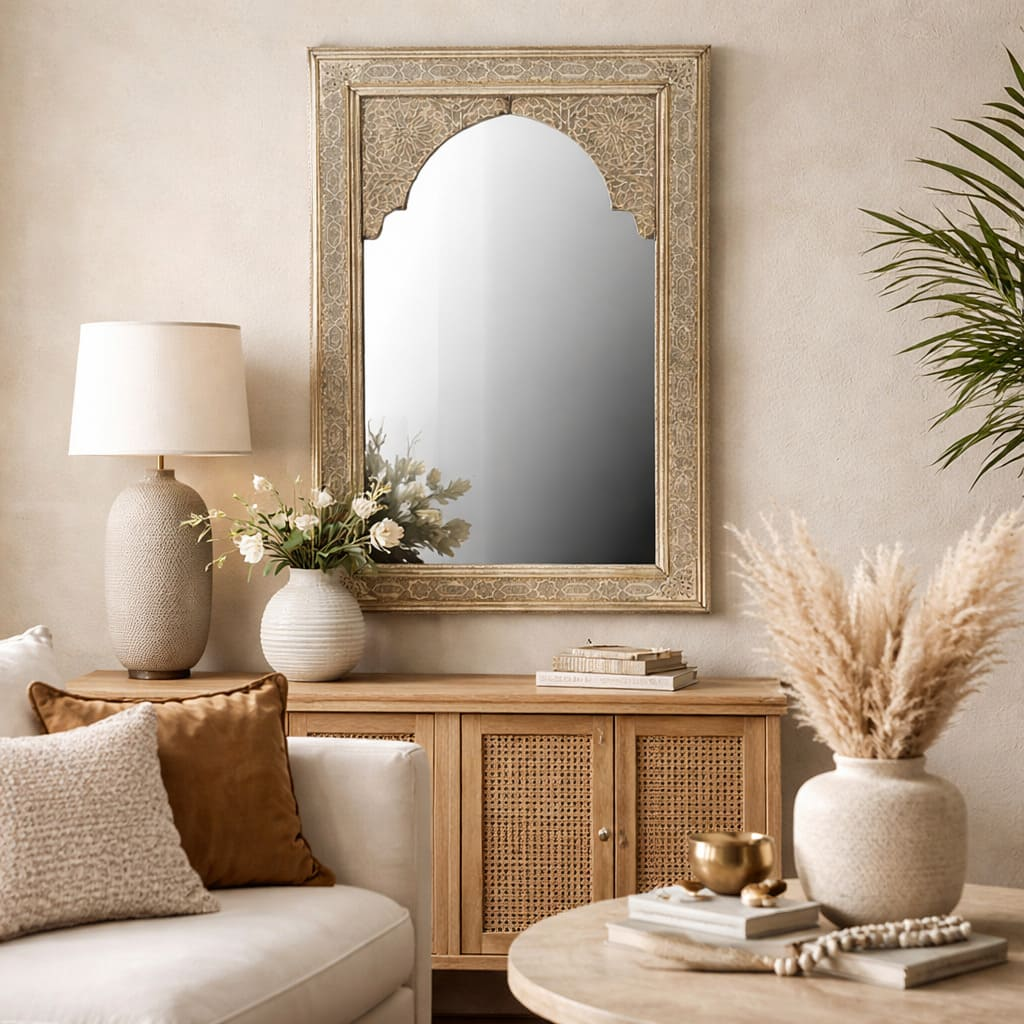
Middle Eastern-inspired mirror frames sell when they feel authentic, not printed-on. The cues buyers borrow—arched tops, lattice-like geometry, carved depth—come from architectural elements that historically balanced privacy, ventilation, and filtered light. The Met’s mashrabiya screens, for example, explicitly note how latticework improves interior ventilation while maintaining privacy—exactly why the pattern still reads “real” to customers.
So in my line reviews, “Middle Eastern inspired” isn’t just a style tag. It’s a proportion rule:
-
arch radius that looks correct at distance
-
pattern density that feels crafted (not noisy)
-
depth and shadow that holds up under store lighting
Resin wall mirror vs iron frame mirror: here’s how buyers actually decide.
If you’re offering both resin wall mirror and iron frame mirror options, you’re speaking my language—because they play different roles in the assortment.
-
Resin wall mirror is where I go for ornament: carved motifs, crest shapes, floral relief, antique effects. It’s often my “visual hook” on the wall.
-
Iron frame mirror is where I go for confidence: thin profiles, cleaner lines, sturdier feel, and usually better long-term consistency for reorders (especially when the finish standard is controlled).
What I want from you is not “we can do both.”
I want: which one you recommend for my channel (mall retail vs hospitality), and what you’re doing to keep finishes consistent across batches.
KSA hospitality mirror supply is growing—so requirements are getting stricter.
If you’re targeting KSA hospitality mirror supply, the opportunity is real—and buyers will scrutinize execution. Saudi Arabia’s hotel pipeline continues to expand under Vision 2030; major market reviews highlight very large room counts planned/under construction (especially in Makkah/Madinah), reinforcing long-term hospitality demand.
And investment news shows how serious the build-out is—Reuters reported a multi-billion-dollar hospitality investment portfolio aimed at developing thousands of hotel units.
Hospitality buyers care about:
-
mounting reliability (no surprises on site)
-
consistent finishes across multiple properties
-
packaging that reduces damage claims and replacement cycles
-
documentation that speeds procurement approvals
In other words: hospitality doesn’t buy “pretty.” It buys predictable.
Mirror packaging is not a cost. It’s a profit lever.
For mirrors, the most expensive problem is damage-rate drift—when packaging looks fine for one shipment and fails on the next.
This is why I like suppliers who can speak to packaging testing in a grown-up way. ISTA’s procedures are commonly used to simulate distribution hazards—shock (drops), vibration, and compression—the same physics that punish mirrors in transit.
My buyer checklist for mirror packaging:
-
corner protection that doesn’t shift under vibration
-
glass surface protection that avoids rub marks
-
carton strength designed for stacking/compression (not hope)
-
clean unboxing (less mess = less store labor)
If you help me reduce damage and store handling time, you just improved my margin without touching unit price.
Bathroom mirror ideas that actually sell: shoppers are paying for features now.
When I add “bath” into the mix, I’m not guessing. Homeowners are actively choosing mirrors with specialty features—Houzz’s 2025 U.S. Bathroom Trends Study reports that 34% select mirrors with specialty features, including LED lighting (24%) and anti-fog systems (22%).
So if you’re pitching bathroom mirror ideas, don’t just show shapes—show the feature map:
-
LED illumination options
-
anti-fog capability
-
mounting systems that installers don’t hate
-
packaging that protects electronics and glass
Where Teruier’s model fits (without the jargon)
Here’s the part suppliers often miss: buyers don’t need more inspiration—we need fewer surprises.
Teruier’s “cross-border design + manufacturing collaboration” approach (rooted in a craft hub, plus value translation, plus a merchant profit plan) is exactly the type of workflow I trust:
-
take a Middle Eastern-inspired brief and turn it into measurable specs
-
lock finishes and hardware so reorders look the same
-
engineer packaging to protect margin, not just product
-
build assortments that work for both mall retail and KSA hospitality procurement
That’s not branding. That’s risk control.
The one-page supplier scorecard I use before I approve a mirror program
If you want me to scale a Middle Eastern inspired mirrors wholesale line with you, show me:
-
resin vs iron recommendations by channel (retail vs hospitality)
-
a finish control standard (so “antique gold” stays antique gold)
-
packaging built for shock/vibration/compression realities (ISTA-style thinking)
-
a bath feature roadmap aligned with what shoppers are buying (LED/anti-fog)
-
a KSA hospitality-ready execution plan (consistent batches, documentation, replacement workflow)
If you hit those, you’re not just a mirror vendor—you’re a reorder partner.



