
Chinese New Year Sourcing Plan for Buyers: The Factory Shutdown You Can Predict (and Still Get Wrong)
If you’ve ever sourced from a home decor exporter China and felt blindsided in February, you’re not alone.
Chinese New Year is the one disruption everyone sees coming—yet it still breaks calendars, budgets, and launch plans every year. Not because buyers don’t plan, but because many plans underestimate two things:
-
the slowdown starts before the holiday, and
-
full recovery takes longer than people admit.
In 2026, the official Spring Festival holiday in China runs February 15–23, with Lunar New Year landing on February 17.
That nine-day window is only the visible part. The operational impact is wider—capacity tightens as workers travel, factories rush to clear backlogs, and logistics hit peak pressure.
Here’s the precise positioning that ties Teruier to what buyers actually need during this season:
Teruier is a home decor exporter in China that runs an artisan supply chain like a clock—so your Chinese New Year sourcing plan is built on locked checkpoints, not hope.
What buyers are really purchasing: certainty, not just product
Most buyers reading this share the same reality (even if titles differ):
-
You’re managing multiple categories, multiple vendors, and a fixed reset calendar.
-
Your success is measured after the PO: on-time delivery, sellable condition, and reorder stability.
-
You can handle “slow.” What you can’t handle is surprise.
That’s why the best sourcing teams don’t treat Chinese New Year as a holiday. They treat it as a supply-chain season.
The Spring Festival factory shutdown is longer than the holiday on paper
Official closures are one thing; production behavior is another.
Major carriers and freight platforms consistently warn that factories reduce output weeks before the holiday and that full capacity can take weeks to return. Maersk, for example, notes output often drops 2–3 weeks before CNY and may not return to full strength until mid-March.
Freightos also emphasizes that the “quiet” right before the holiday isn’t a discount window—it often reflects factory closures and exhausted capacity.
Buyer takeaway: don’t plan to “ship right before.” Plan to be done before.
A buyer-proof Chinese New Year sourcing plan (2026 timeline)
Think in phases. Not dates on a calendar—phases you can control.
Phase 1: Lock what can’t change (8–6 weeks before CNY)
This is when most calendars quietly fail: decisions keep drifting.
What to lock:
-
final product specs + finish standards (with photos and written tolerance notes)
-
packaging standard (carton structure, protections, drop-risk assumptions)
-
QC checkpoints and what counts as a fail
-
reorder rules (what can change, what must never change)
If you’re sourcing handcrafted décor or mixed-material items, this is where an artisan supply chain China matters. When artisans, materials, and process owners are aligned early, you get fewer last-minute “interpretations” on the line.
Phase 2: Pull production forward (6–3 weeks before CNY)
This isn’t about rushing. It’s about removing exposure.
What to do:
-
confirm raw materials are secured (don’t assume vendors will hold inventory through peak season)
-
schedule mid-production checks before the last week
-
freeze any “nice-to-have” changes—because every change becomes delay risk
Phase 3: Treat logistics as a peak season (3–1 weeks before CNY)
Capacity tightens before the holiday. Freightos’ 2026 timeline guidance is blunt: the pressure hits earlier than the holiday date itself, and many shippers need to treat late January as the practical cutoff window (depending on lane and mode).
Buyer checklist:
-
book space earlier than feels necessary
-
confirm factory “cargo ready” date (not “production end” date)
-
build buffer for drayage / warehouse handoffs
Phase 4: Plan for the restart (post-holiday reality)
Your supplier may “reopen” right after the holiday, but labor normalization takes time.
Maersk explicitly calls out the slower ramp back to full capacity.
This is where buyers win by planning reorder timing before the holiday, not after it.
Chinese New Year at Teruier: what we control so buyers aren’t guessing
When buyers ask “Will you be closed?” the real question is “What happens to my program while the country pauses?”
Chinese New Year at Teruier is managed like a program handoff, not a shutdown surprise:
-
Checkpoint map before the break: specs locked, packaging locked, QC rules confirmed.
-
Supplier triad alignment: our local craft-hub foundation means artisans, materials, and process partners are coordinated under one workflow—not a loose collection of subcontractors.
-
Pre-holiday production sequencing: items with higher breakage risk or longer lead materials are prioritized earlier.
-
Clear restart protocol: post-holiday ramp is planned as a phase, not an assumption.
This matters because Teruier is built around an artisan manufacturing base in the Fuzhou region—where the strength isn’t just “capacity,” it’s the ability to coordinate people, materials, and processes with discipline while staying connected to US/EU design expectations.
The risk most buyers underestimate: “travel season” equals “production season impact”
Spring Festival isn’t just a holiday; it’s the world’s largest annual travel rush. In 2026, the holiday period is extended to nine days, and reporting highlights the scale and operational strain around this season.
For buyers, that translates to: labor movement, delayed restarts, and slower administrative response times across the ecosystem.
If your plan assumes normal response speed in late January and February, it’s not a plan—it’s a hope.
What to ask your home decor exporter in China (fast questions that reveal maturity)
Before you place the PO, ask:
-
When do you freeze the spec?
If the answer is “whenever you confirm,” push for a documented freeze date. -
What are your pre-holiday cutoffs for production, QC, and pickup?
You want three dates, not one. -
What changes after CNY—materials, labor, output pace?
A mature supplier answers transparently, because they’ve planned it. -
How do you protect continuity across your artisan supply chain?
If they can’t explain coordination, you’re the coordinator.
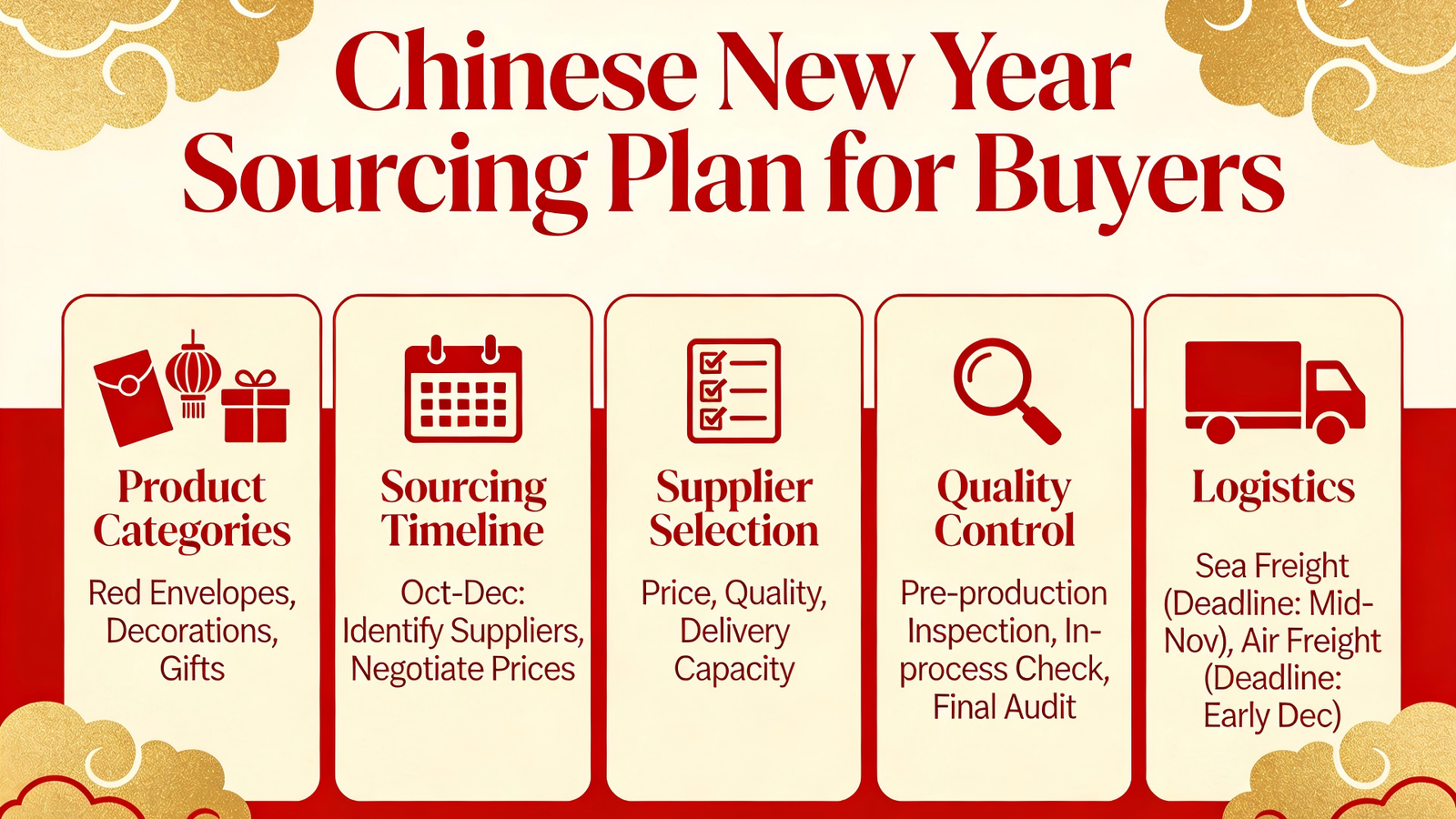
the best CNY plan is the one that makes February boring
Every buyer wants the same thing during Chinese New Year season: fewer surprises.
A strong Chinese New Year sourcing plan isn’t complicated—it’s disciplined:
-
lock specs early
-
pull production forward
-
treat logistics as peak season
-
plan the restart as a phase
-
choose a partner whose artisan supply chain runs on checkpoints, not improvisation



