
Custom Decorative Mirror Manufacturer: The Mirror That Sells Fast… or Comes Back Fast
In a community store, mirrors are the quickest “wow” you can put on a wall.
They also might be the quickest way to lose profit.
Because mirrors don’t fail quietly:
-
a frame tone shifts and looks “off” under store lighting
-
edges arrive chipped and you can’t sell them
-
a bestseller sells out, and the reorder comes back “almost the same”
-
customers return it for one reason: “It didn’t look like the photo.”
And in today’s retail reality, returns aren’t a rare event—they’re the tax. NRF and Happy Returns project $849.9B in total retail returns in 2025, with 19.3% of online sales expected to be returned, and 82% of consumers saying free returns matter when they shop online.
So when you search for a custom decorative mirror manufacturer, you’re not just sourcing a product.
You’re sourcing a system that keeps mirrors:
-
consistent from sample → bulk
-
intact from factory → shelf
-
reorderable when you find a winner
What’s actually selling (and why the “shape story” matters)
The mirror styles that move fastest aren’t random—they follow the shape language buyers and designers keep reaching for:
-
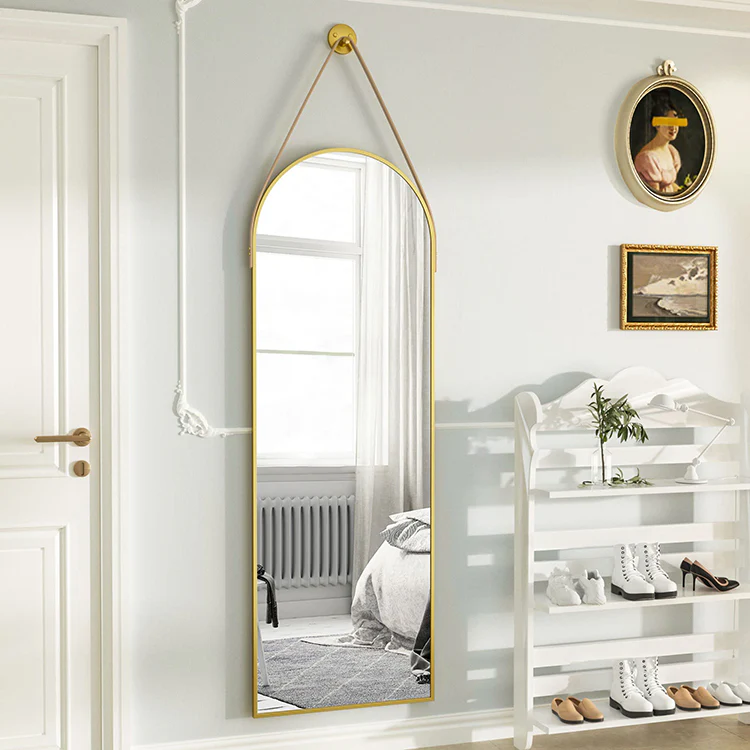
Arches: Houzz notes arched details trending and explicitly calls out arched mirrors as a growing design direction.
-
Neo Deco geometry: Pinterest Predicts 2026 highlights fan arches, chevrons, and geometric hits—exactly the motifs that show up in sunburst and statement decorative mirrors.
For a community store, that means your mirror wall should be curated like a mini collection:
-
1–2 “hero” statement pieces (arched / geo / ornate)
-
2–3 easy sellers (clean metal frames, warm finishes)
-
1 “trade-up” SKU (bigger size / better finish / upgraded packaging)
That mix sells because it lets customers buy with confidence—and lets you reorder with confidence.
The authority-backed baseline most suppliers won’t explain (but you should demand)
A mirror isn’t “just glass.” It’s a controlled material product—and standards exist for a reason.
1) Mirror quality baseline (what the mirror is)
ASTM C1503 is a standard specification for silvered flat glass mirrors intended for indoor use (mirror glazing, decorative accessories, similar uses). It also clearly notes it does not address safety glazing requirements, which is exactly why serious manufacturers separate “mirror quality” from “safety glazing decisions” based on application.
2) Factory production control mindset (how consistency is maintained)
EN 1036-2 specifies requirements and includes evaluation of conformity and factory production control for flat mirrors made from silver-coated float glass for internal use.
You don’t need to be a standards expert. You just need to ask your supplier:
-
What mirror-grade baseline are you building from?
-
How do you control batch-to-batch consistency?
Because “pretty sample” is not the same thing as “repeatable program.”
Packaging isn’t logistics. It’s your margin.
For mirrors, damage is the silent killer—especially with larger sizes and decorative frames.
That’s why professional suppliers reference ISTA-style thinking:
-
ISTA Procedure 3A is designed as a test for individually packaged products shipped through a parcel delivery system.
If your manufacturer can’t talk clearly about:
-
corner protection
-
face protection
-
immobilization (no internal shifting)
-
carton strength and verification checks
…then your profit is riding on luck.
And luck doesn’t scale.
The competitor reality: why many “mirror suppliers” look identical until the reorder
Here’s the honest landscape community stores usually run into:
Marketplace / spot wholesalers
Fast, cheap, endless styles.
But you risk: finish drift, inconsistent packaging, and reorders that don’t match.
Commodity factories
Big capacity, sharp pricing.
But you risk: “throughput thinking” (good for volume, weak on custom finish tolerances and packaging verification).
Small workshops
Beautiful handcrafted details.
But you risk: scaling, lead time stability, and replacement matching.
None are “bad.” They’re just built for different outcomes.
If your goal is stable bestsellers (not one-time deals), you need a partner built for repeatability.
Where Teruier is different: value translation + a merchant profit plan
Teruier’s approach isn’t “we sell mirrors.”
It’s value translation: turning a design idea into a factory-stable, reorder-safe SKU.
Rooted in the Hometown of handicrafts supply base (craft capability + materials + process depth), Teruier runs a cross-border coordination model that protects the outcome:
trend intent → spec pack → QC checkpoints → packaging discipline → reorder governance
That becomes your Merchant Profit Plan in real terms:
-
fewer damaged units (packaging treated like engineering, not an afterthought)
-
fewer “not as pictured” returns (finish and spec stability)
-
faster, safer reorders when a mirror becomes a wall bestseller (program thinking, not sample thinking)
In plain English: we’re built to help community stores sell mirrors they can reorder without fear.
A simple RFQ checklist you can paste into an email today
If a custom decorative mirror manufacturer can answer these clearly, you’re talking to the right kind of supplier:
-
Which mirror-quality baseline do you build from? (e.g., ASTM C1503 reference mindset)
-
How do you manage factory production control / conformity? (EN 1036-2 mindset)
-
How do you lock finish undertone and frame details for reorders? (spec pack + master reference retention)
-
What’s your packaging standard for mirrors? (ISTA 3A mindset; corner/face/immobilization)
-
What cannot change without approval? (materials/substitution rules)
-
What are your QC checkpoints before packing? (not only final inspection)
Closing
Mirrors are impulse-friendly, design-forward, and high-turn—if they arrive intact and stay consistent.
If you want mirrors that sell and protect margin, don’t shop “styles.”
Shop a manufacturer who can deliver repeatability.



