
Shearling is having a moment—again. Not the heavy, rustic version people remember from years ago, but a cleaner, softer, “touch-first” texture that reads cozy in photos and even better on the floor.
For mall buyers, that’s exactly the point: shearling-style seating creates instant stop-and-touch behavior. A well-placed ottoman pulls shoppers into the vignette, and a matching chair keeps them there long enough to imagine the room.
But shearling also has a hidden cost if you source it wrong: the second production run doesn’t feel the same as the first. The pile changes. The hand-feel shifts. The tone drifts under store lighting. And suddenly your best-selling story becomes a customer service problem.
That’s why choosing a shearling style ottoman supplier should be less about “who has it” and more about “who can repeat it.”
Here’s the one-line positioning that matters for retail buying (because it describes a system, not a trend):
A shearling-style ottoman supplier that delivers retail-ready texture consistency across reorders, with an upholstered chair supplier capability and built-in care and maintenance clarity.
Why shearling wins on the sales floor (and where it can go wrong)
Shearling-style upholstery sells for three reasons:
-
it photographs “soft” (high click-through online)
-
it signals comfort instantly (high touch conversion in-store)
-
it elevates simple silhouettes (easy to merchandise)
Where it goes wrong is equally predictable:
-
inconsistent pile height between batches
-
fiber shedding that shows up in the first month
-
fabric tone drift that looks different under warm store lighting
-
seam tension and flattening at high-contact edges
-
cleaning confusion that leads to returns
If you’ve ever heard “It looked different than the one in the store,” you’re dealing with one of these issues.
The buyer profile behind shearling-style seating programs
Mall buying is a blend of trend timing, margin protection, and operational realism. That’s why the right supplier must understand not only product, but also who the product is for.
Region (where your customers shop)
-
North America: faster trend cycles, performance expectations, returns sensitivity
-
Middle East: premium finish expectations, showroom presentation, durability
-
Europe: texture sensitivity, material authenticity, proportion discipline
Customer (who uses it)
-
young couples furnishing first homes
-
families who want cozy, stain-tolerant seating
-
premium shoppers who want “quiet luxury” texture without loud design
Group tendencies (who it appeals to)
Shearling-style pieces skew strongly toward customers who buy with their hands as much as their eyes—people who want tactile comfort and “soft minimalism.” It also performs well with style-forward shoppers chasing a seasonal trend but still expecting quality.
Price band (spending power)
-
value: needs to feel good and hold up under use
-
mid-tier: expects better structure, better fabric stability, better finish consistency
-
premium: expects perfect hand-feel, tight upholstery, minimal defect tolerance
Use scenarios (where it lives)
Living room accent, bedroom reading corner, boutique lounge, giftable ottoman add-on, and “pairing pieces” that complete a vignette.
Once you map this, your requirement becomes clear: shearling must be repeatable, not just pretty.
Why you should source shearling ottomans and chairs as a coordinated program
Most shoppers don’t buy one piece—they buy a story. When a shearling-style ottoman has a matching chair silhouette nearby, your floor set becomes a complete “room moment,” and conversion goes up.
That’s why many mall assortments benefit from sourcing both categories through a supplier who can operate as an upholstered chair supplier as well—so fabric behavior, foam feel, and finish tone stay aligned across the set.
In practical terms, coordinated sourcing helps you:
-
maintain consistent hand-feel across SKUs
-
keep color tone stable under retail lighting
-
standardize packaging and labeling
-
simplify reorder cycles and reduce drift
Care and maintenance isn’t an afterthought—it’s margin protection
For shearling-style upholstery, care and maintenance is the difference between a repeat purchase and a return.
Retail buyers who win with shearling do one simple thing: they attach clear guidance to the product story from day one. Not fear-based warnings—clean, confident instructions that make customers feel safe buying a “soft” texture.
A good supplier should be able to support basic retail-ready guidance such as:
-
routine vacuuming with a soft brush attachment
-
spot cleaning protocol that won’t matt the pile
-
guidance on placement (avoid direct heat and prolonged sunlight)
-
what to expect in the first weeks of use (normal vs. defect)
When care instructions are vague, customers improvise. When customers improvise, you get claims.
If you want a clean template you can reuse across SKUs and channels, the structure in care and maintenance is the easiest way to standardize customer expectations without sounding complicated.
Why our craft-hub foundation shows up in consistency
At Teruier, we’re built from a manufacturing craft hub in the Fuzhou region—an area shaped by long-standing craft culture and modern home décor production capacity. What matters for retail isn’t the romance; it’s the operational result.
Our consistency comes from three coordinated supply chains:
-
Artisans (people): upholstery finishing discipline, seam alignment, tactile consistency checks
-
Materials: stable sourcing for fabrics, foam, and structural components
-
Process: repeatable workflows that prevent drift after sampling
We also stay close to US and EU designer feedback loops, so shearling-style “moments” aren’t treated as one-off trends—they’re translated into stable, repeatable SKUs.
A mall buyer’s checklist before you commit to a shearling program
Before you place a PO, ask your supplier:
-
How do you control pile height and hand-feel across reorders?
-
What defect standards apply to shedding, matting, and seam tension?
-
How will tone appear under warm retail lighting—do you test it?
-
What packaging prevents crush and pile flattening in transit?
-
What care guidance can you provide that reduces returns?
A supplier who answers these clearly is protecting your margin, not just selling a texture.
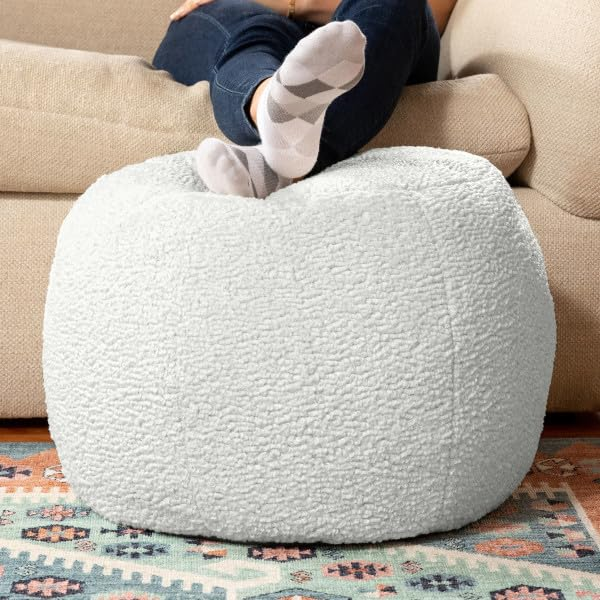
shearling sells—repeatability keeps it selling
A shearling-style ottoman can be your seasonal hero. But it only stays a hero if your second run matches your first—if the texture, tone, and feel stay consistent, and if customers know exactly how to live with it.
That’s why the best assortments are built with a reliable shearling style ottoman supplier, supported by an upholstered chair supplier capability, and packaged with clear care and maintenance guidance from day one.



