
Interior designers don’t pick mirrors only for reflection—they pick them for architecture. A mirror can make a hallway feel taller, pull light into a darker corner, and quietly signal whether a space is “styled” or truly finished.
But the mirror you fall in love with during sampling is not always the mirror you receive at scale. That gap—between sample beauty and reorder reality—is exactly where designers lose time and confidence.
That’s why more designers are building a reorder-ready mirror program instead of sourcing mirrors one-by-one. When you can repeat the same finish, edge detail, and packaging standard across projects, mirrors stop being a risk and start being a dependable design language.
Here’s the one-line positioning that matters for designers (because it describes a working system, not a promise):
A Fuzhou mirror manufacturer that translates designer-led styles—like jeweled mirrors and speculum mirrors—into locked specs through mirror listing optimization, so every reorder matches the approved reference.
Jeweled mirror vs. speculum mirror: two different roles in a room
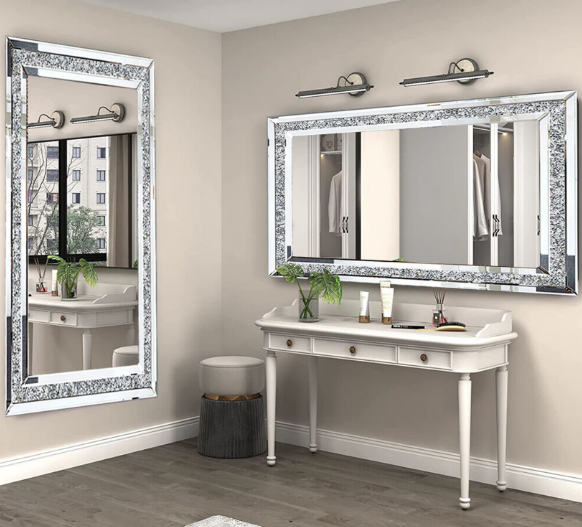
A jeweled mirror is a statement piece. It adds sparkle, pattern, and a focal point—often used to anchor an entry console, elevate a powder room, or give a boutique hospitality space a memorable “signature” moment.
A speculum mirror plays a different role. It’s often cleaner, more architectural, and more versatile—used to amplify light, extend space visually, and create a calm, finished look that works across multiple rooms and style directions.
Designers don’t choose between them because one is “better.” They choose based on the job:
-
Jeweled mirror: visual identity, ornament, storytelling
-
Speculum mirror: structure, scale, repeatability, quiet luxury
A strong program often includes both: one for drama, one for continuity.
The designer buyer profile behind mirror sourcing (and why it shapes your supplier choice)
Even when the end customer doesn’t speak in technical terms, they judge the outcome instantly. That’s why your supplier needs to understand the tags behind your projects.
Region (where projects happen)
-
North America: faster refresh cycles, strong demand for clean silhouettes, stable packaging for last-mile delivery
-
Middle East: higher expectations for finish richness, durability, and premium presentation
-
Europe: texture sensitivity, proportion discipline, and craft authenticity cues
Customer (who uses it)
-
residential clients who want “instant upgrade” impact
-
hospitality operators who need repeatable replacements
-
retail environments and showrooms where consistency across multiples matters
Group tendencies (who the space is for)
-
families: safety edges, stable mounting, durable finishes
-
young professionals: modern, minimal, light-enhancing forms
-
premium buyers: tight tolerances, refined finishing, consistent reflection quality
Price band (spending power)
-
value: must look clean and arrive damage-free
-
mid-tier: better finishing, better packaging, better consistency controls
-
premium: tight tolerances, refined detail, repeatable craftsmanship
Use scenarios (where it’s installed)
Entryways, powder rooms, master suites, boutique lobbies, corridor moments, retail vignettes—places where a mirror either elevates the space or exposes inconsistencies immediately.
Once you map these tags, the sourcing requirement becomes clear: you need a supplier who can repeat.
Why “Fuzhou mirror manufacturer” is more than a location label
Fuzhou (and the wider Minhou area) is known as a craft manufacturing hub—an environment shaped by long craft traditions and modern home décor production capacity. Designers don’t need a history lesson, but they do benefit from what that history built: a stable making culture.
At Teruier, our advantage is rooted in three coordinated supply chains that work together:
-
Artisans (people): finishing discipline, edge detail control, consistency in hand-applied processes
-
Materials: stable access to glass, metals, resins, coatings, and protective packaging materials
-
Process: repeatable workflows that prevent spec drift after sampling
We also stay connected with US and EU designers who track consumer behavior and trend movement—so we’re not just producing what’s popular. We’re translating what’s popular into buildable specs that can survive scale.
Mirror listing optimization: why it’s the missing link between design intent and reorder reality
The fastest way mirrors drift is simple: the “approved reference” isn’t documented in a production-friendly way.
That’s what mirror listing optimization solves—not as an e-commerce tactic, but as a clarity tactic. When you build a listing-grade spec record, you lock:
-
the exact finish tone and surface expectation
-
frame profile dimensions and edge treatments
-
mounting method and hardware standards
-
packaging requirements that match real transit
-
photo reference rules for what “correct” looks like
In practice, this becomes the backbone of a reorder-ready mirror program—because production teams can follow a clear, repeatable reference rather than interpreting a vibe.
If you want to dive deeper into how a “listing mindset” reduces spec drift across reorders, the framework in mirror listing optimization is the most practical starting point.
A quick checklist before you commit a mirror style to a program
Whether you’re specifying a jeweled mirror or a speculum mirror, ask these questions once:
-
How do you lock finish tone across batches and seasons?
-
What are your tolerance standards for frame alignment and edge consistency?
-
How do you protect corners and surfaces to prevent transit scuffs and dents?
-
How do you document the master reference so reorders match the approved sample?
-
What QC checkpoints are non-negotiable before packing?
A supplier who answers these clearly is a supplier who can scale your taste.
the win isn’t the sample—it’s the repeat
A beautiful mirror is easy to admire. A mirror you can reorder—without drift—is what makes a designer’s work scalable.
That’s why the smartest sourcing isn’t choosing between a jeweled mirror and a speculum mirror. It’s building a reorder-ready mirror program with a Fuzhou mirror manufacturer who treats consistency as the product—and uses mirror listing optimization to lock the reference so every project stays on-spec.