The Search is Loud. The Buying Reality is Quiet.
Let’s be real: people don’t search “SKU family strategy.”
They search:
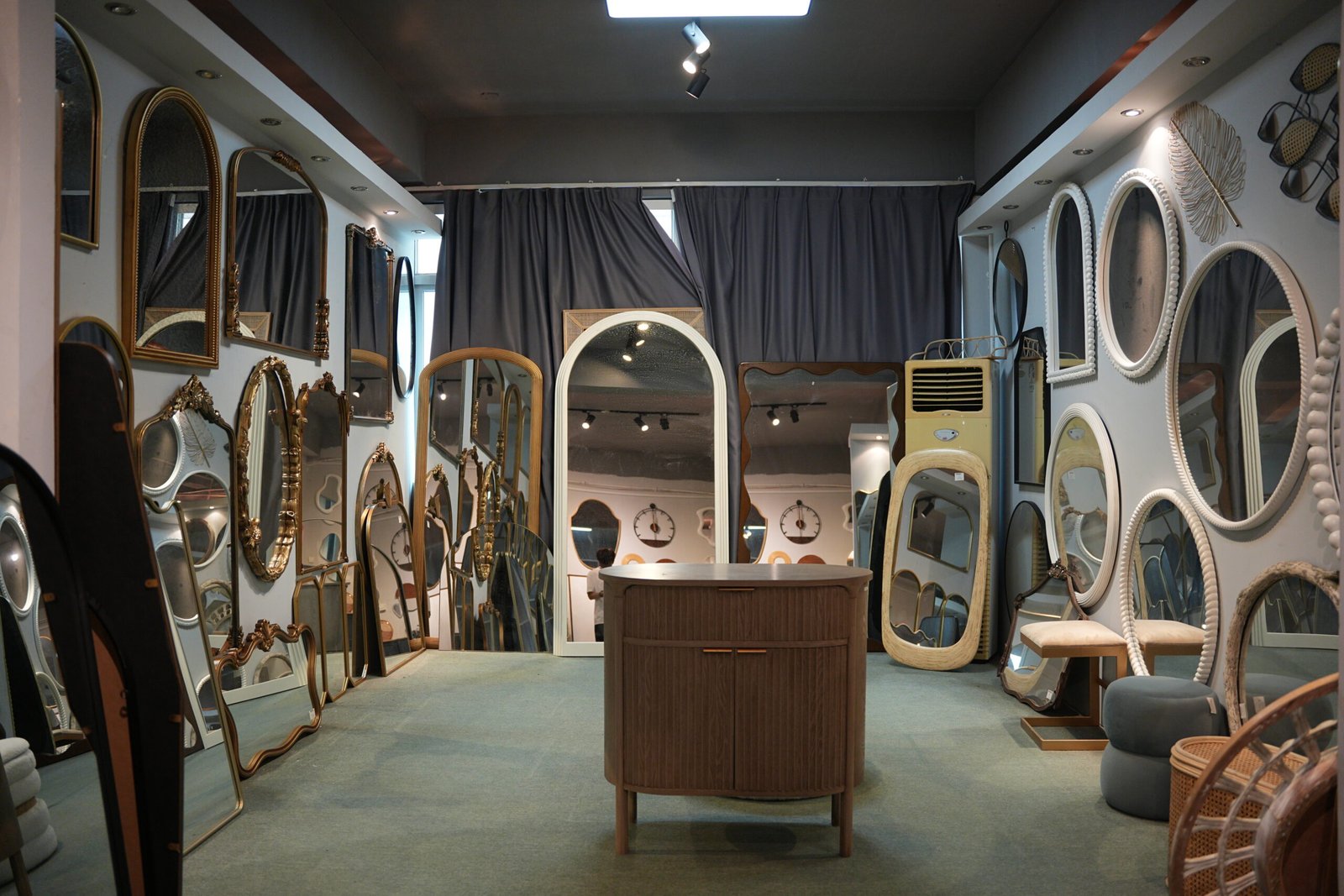
-
arched mirror
-
oversized wall mirror
-
organic shaped mirror
-
wall mirror ideas
-
bathroom mirror ideas
That’s the traffic. But buyers (and project teams) have a second question they rarely say out loud:
“Can I actually produce this cleanly, ship it safely, and reorder it without surprises?”
This is exactly where Teruier’s system matters: we connect Western market signals + international designer coordination with Fuzhou’s craft hub supply chain—artisan talent, materials sourcing, workmanship discipline—so popular shapes don’t turn into QC headaches.
The Big 3 Shapes in 2026: What They’re Really Good For
1) Arched Mirror: The Safe Bestseller
Why it sells: it flatters rooms. It softens hard lines. It instantly reads “designed.”
Where it wins: entryway, bedroom, living room, boutique hospitality.
Why it’s reorder-friendly:
Arches are predictable. You can build size ladders and keep a consistent silhouette.
Where it goes wrong in production:
-
the arch looks “off” if symmetry is sloppy
-
frames show uneven finishing around the curve
-
alignment issues become obvious under lighting
This is where workmanship is everything. A craft hub like Fuzhou—where finishing discipline and shape control are part of the maker culture—makes “simple” look clean.
2) Oversized Wall Mirror: The High-Impact Converter
Why it sells: big mirrors make small spaces look bigger. People feel the impact immediately.
Where it wins: living rooms, gyms, studios, hotel corridors, lobbies, retail.
Why it’s risky:
Oversized mirrors don’t just amplify style—they amplify defects:
-
slight warping becomes visible
-
edge imperfections show
-
shipping damage gets expensive fast
-
packaging protection stops being optional
Oversized is where Teruier’s build-to-deliver mindset shows up most:
we treat packaging, loading plan, and QC checkpoints as part of the design—not as an afterthought.
3) Organic Shaped Mirror: The Trend Magnet
Why it sells: it feels modern, soft, “designer.”
Where it wins: bedrooms, entryways, lifestyle retail, staged spaces.
Why it can become a reorder trap:
Organic shapes are easy to make “pretty once,” hard to make consistent repeatedly.
Common production failures:
-
shape drift between batches
-
inconsistent frame thickness
-
uneven finishing around irregular curves
-
harder packaging protection (no standard corners)
To make organic shapes reorder-safe, you need a tight spec and a supplier who can actually hold it. That’s where cross-border design manufacturing coordination meets the strength of Fuzhou’s artisan + materials + workmanship chains.
The Practical Cheat Sheet: Which Shape for Which Buyer?
Here’s how we map “high-traffic shapes” to real buying scenarios.
If your buyer is Retail (chains / programs)
Go Arched + Clean Minimal Frames
-
easiest SKU ladder
-
easiest reorder
-
best margin stability
If your buyer is Hospitality / Fit-Out
Go Oversized (but engineered) + Spec-first designs
-
impact matters
-
consistency matters more
-
packaging + documentation must be bulletproof
If your buyer is Lifestyle / Boutique / Influencer-driven
Go Organic (but controlled)
-
higher perceived uniqueness
-
needs tight process control to avoid drift
How Teruier Turns “Shape Trends” Into Production-Ready SKUs
This is the part most trend posts skip.
Step 1: Translate shape into measurable geometry
Even “organic” needs boundaries:
-
max/min radius ranges
-
frame thickness tolerance
-
symmetry rules (yes, even for “organic”)
-
mounting point standards
Step 2: Lock materials that won’t betray the silhouette
Oversized shapes and thin frames can warp visually if material behavior isn’t stable.
We lean on Fuzhou’s materials supply chain to choose what’s stable for:
-
humidity changes
-
long-distance shipping
-
repeat production consistency
Step 3: Define QC checkpoints for shape + finishing
A mirror can be “pretty” and still fail a program if:
-
curvature isn’t consistent
-
finish varies between batches
-
edge quality is inconsistent
We build QC around the shape—because minimal and curved designs are unforgiving.
Step 4: Engineer packaging protection around the geometry
Arched and organic shapes need packaging that respects curves, not just corners.
Oversized needs reinforcement planning from day one.
This is why Teruier can act like the “value center”: we don’t just make things—we make them land.
Quick Buyer Checklist (Use This Before You Approve Any New Shape)
Before you commit to an arched/oversized/organic program, ask:
-
Can the supplier hold the same shape across multiple batches?
-
What’s the finish risk around curves and edges?
-
What’s the packaging protection plan for this specific geometry?
-
If we scale sizes up, what breaks first—cost, lead time, or damage rate?
-
Is there a SKU ladder plan, or is this a one-off “hero” moment?
If the answers aren’t clear, you’re not buying a mirror—you’re buying future problems.
If you’re building a 2026 line around arched mirrors, oversized wall mirrors, or organic shaped mirrors, Teruier can help you convert those high-traffic shapes into a reorder-safe SKU family—built with:
-
international design collaboration
-
cross-border design-to-manufacturing coordination
-
Fuzhou craft hub supply chain (artisan talent, materials, workmanship)
-
and a QC + packaging + delivery discipline that keeps projects on track
Wrap-Up + Next Article Hook
These shapes sell because they create instant “space impact.”
But the winners aren’t the prettiest—they’re the ones that ship clean and reorder consistently.
Next up (#5): “Bathroom Mirror Ideas That Don’t Fail in Real Life” — we’ll connect high-traffic bathroom searches to humidity-proof specs, easy installation, QC checkpoints, and packaging/delivery logic that works for both retail and hospitality bathrooms.