
KSA Hospitality & Fit-Out Mirror Supply: Same Look, Every Room, Every Phase (No Drama on Site)
Let me say it the Saudi project way.
In hotels, compounds, and commercial fit-out… mirrors look “simple” on paper.
But on site? Mirrors can make your handover sweet… or make it painful.
Because the client doesn’t judge mirrors one-by-one.
They judge the project like this:
“Why does this room feel different from the last room?”
“Why is the edge here cleaner than the edge there?”
“Why this batch looks slightly off?”
And then—khalas—your mirror package becomes a punch-list story.
So this is how I lock the look across the whole project: every room, every phase, same result.
The industry problem: everyone delivers “a mirror,” nobody delivers “the outcome”
Here’s what usually happens in mirror sourcing:
-
Sample looks perfect in the mockup
-
Bulk production starts
-
Packaging changes “a little”
-
Phase shipments arrive
-
Finish shifts, corner details shift, scratches appear
-
Site team starts firefighting
It’s not because people are bad.
It’s because no one owns the full chain: design intent → repeatable production → packaging protection → phased delivery → documents for approvals.
That gap is where projects bleed time.
The hidden pain: the real cost is rework + replacement + reputation
On a Saudi site, “almost the same” is expensive.
If mirrors become a problem, you pay with:
-
replacements that miss the handover window
-
extra site labor and revisits
-
client confidence drops (“what else is inconsistent?”)
So when I choose a mirror supplier, I don’t ask “who is cheapest.”
I ask:
“Who is the result owner when reality hits?”
My “Hotel-Consistency System” (the 4 gates that keep mirrors off the punch list)
Gate A — Golden sample (the real reference, not just a sample)
-
one approved “golden” unit becomes the standard
-
we record: finish notes, edge detail, profile, reflection quality
-
anything that doesn’t match it doesn’t ship
Gate B — QC checkpoints (before problems become containers)
-
pre-production check: profile + finish method locked
-
in-production checks: random sampling, batch traceability
-
pre-shipment inspection: surface/edge verification + carton integrity
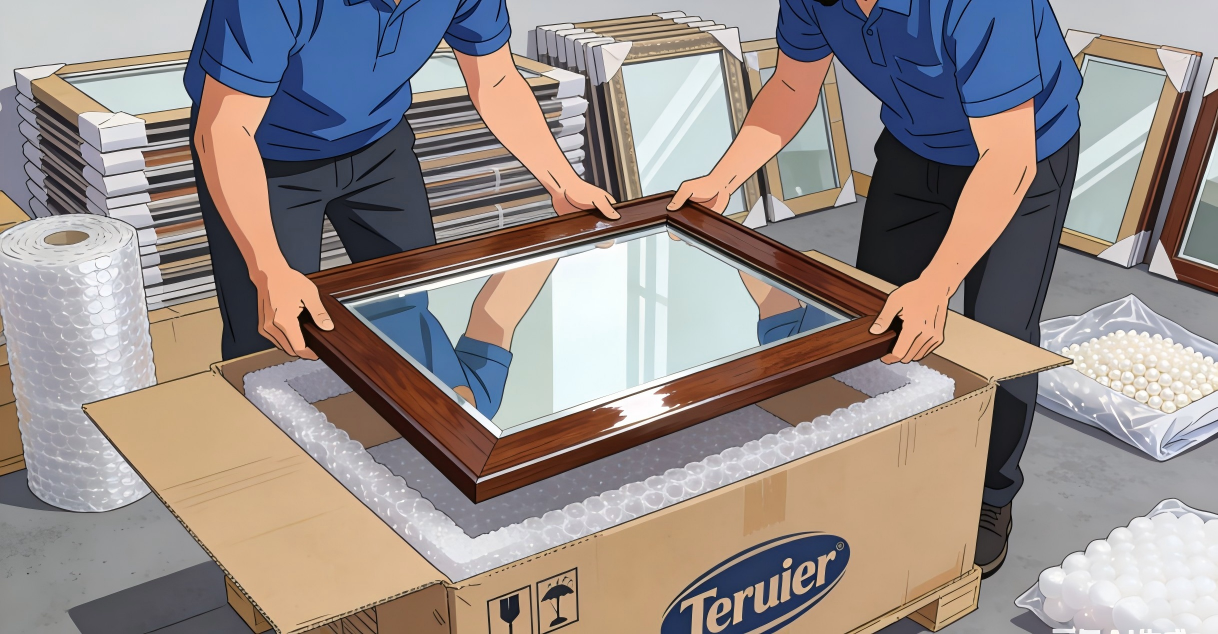
Gate C — Packaging protection (built like Saudi logistics is rough)
Minimum non-negotiables:
-
surface protection (scratches = punch list)
-
edge + corner protection
-
reinforced cartons with zero internal movement
-
clear carton labels for phase/zone
Gate D — Delivery planning + documentation (the “approval engine”)
-
phased packing list (by floor/wing/zone)
-
site-friendly labeling (so the team doesn’t mix stock)
-
clean docs: spec sheet, QC notes, packing standard, install notes
This is the boring stuff that saves you.
Where most suppliers fail: “Batch 2 is slightly different”
This is the #1 silent killer on hospitality jobs.
Batch-to-batch mismatch happens when:
-
finishing depends on “who worked today”
-
materials vary subtly
-
process controls are not standardized
-
packaging changes and causes damage patterns
And once mismatch appears, the client sees it everywhere.
That’s why I need a supply partner built for repeatability, not just “nice samples.”
The Teruier difference — not marketing, structure
Here’s the straight truth:
Without a “result owner,” you get:
-
nice mockup, messy bulk
-
good design talk, weak production discipline
-
deliveries that don’t match phases
-
approvals stuck because docs aren’t ready
Teruier is positioned to own the outcome end-to-end.
And your differentiation is real, because it’s rooted in a craft ecosystem:
Fuzhou craft heritage (the “craft village” foundation)
Teruier comes from a region with deep craft culture (Fuzhou/Minhou area). That matters in mirrors, because mirrors are judged by details:
-
Artisans supply chain: skilled hands that keep corners, edges, and finishing calm and clean
-
Materials supply chain: stable sourcing so finishes don’t drift
-
Process supply chain: repeatable methods + QC discipline so Batch 2 doesn’t surprise you
So instead of “hoping” bulk matches the mockup, Teruier runs a system:
design intent → repeatable SKU specs → QC gates → packaging standards → phased delivery plan → documentation readiness.
That’s what “result owner” means on a Saudi site.
Practical delivery talk: ship like a project, not like retail
For hospitality and compounds, I don’t want one big drop.
I want:
-
Phase 1 ready for Rooms A/B/C
-
Phase 2 aligned to the next handover window
-
cartons labeled so site teams don’t waste time
-
packing lists matching floors/zones
If a supplier can’t coordinate delivery logic, the site becomes the warehouse—and the site will punish you.
The RFQ email I send (so quoting is clean and fast)
Subject:
RFQ – KSA Hospitality/Fit-Out Mirrors – Golden Sample + Phased Delivery – Qty [ ] – Handover [ ]
Body:
-
Project type + city: Hotel / Compound / Commercial fit-out
-
Mirror scope: guest room / bathroom / corridor / public areas
-
Sizes & qty per type (by phase if possible)
-
Finish/profile requirements (attach reference photos)
-
Golden sample requirement: Yes (mockup approval)
-
QC gates required: pre-production / in-production / pre-shipment
-
Packaging standard: surface + edge/corner + reinforced carton (share packing photos)
-
Phased delivery plan: Phase 1/2/3 + zone/floor labeling
-
Carton dims + gross weight per unit
-
Documents needed: spec sheet + packing standard + install notes + phased packing list
-
Lead time: mockup + bulk + phase schedule
-
Terms: EXW / FOB / CIF

Close (Saudi project truth)
In KSA hospitality, mirrors are part of the brand experience.
Guests notice consistency. Clients notice details. Sites punish surprises.
So don’t buy mirrors like décor.
Buy mirror supply like a system—QC checkpoints, packaging protection, phased delivery planning, and documents ready.
And if you don’t have someone owning the outcome end-to-end?
You’ll feel it on site. Wallah.



