For an international home décor buyer, finding an attractive storage product is only the beginning. The real challenge is turning that design into a commercially viable product that can be manufactured, packaged, delivered, and reordered consistently.
Successful storage product development depends on decisions made before bulk production: dimensions, materials, hardware, sample approval, packaging, and production requirements.
For retailers and importers developing private-label storage collections, these decisions determine whether a promising sample becomes a reliable product line.
The Buyer’s Challenge: An Attractive Sample Is Not Yet an Approved Product
Imagine a European home furnishings buyer reviewing several decorative trunks at a sourcing exhibition.
One model has an appealing vintage silhouette. Another offers coordinated pastel colors. A third has a distinctive interior lining.
The buyer wants to develop a storage collection for an existing retail brand, but the original designs do not fully match the intended assortment.
Perhaps the largest trunk is too wide for the target retail display. The handles need a different finish. The packaging must accommodate individual online orders.
These changes may appear minor, yet each can influence construction, cost, and production feasibility.
This illustrative scenario explains why home décor product samples need to be evaluated as working products rather than simply attractive references.
Start With an Existing Product: Teruier TDS27-08
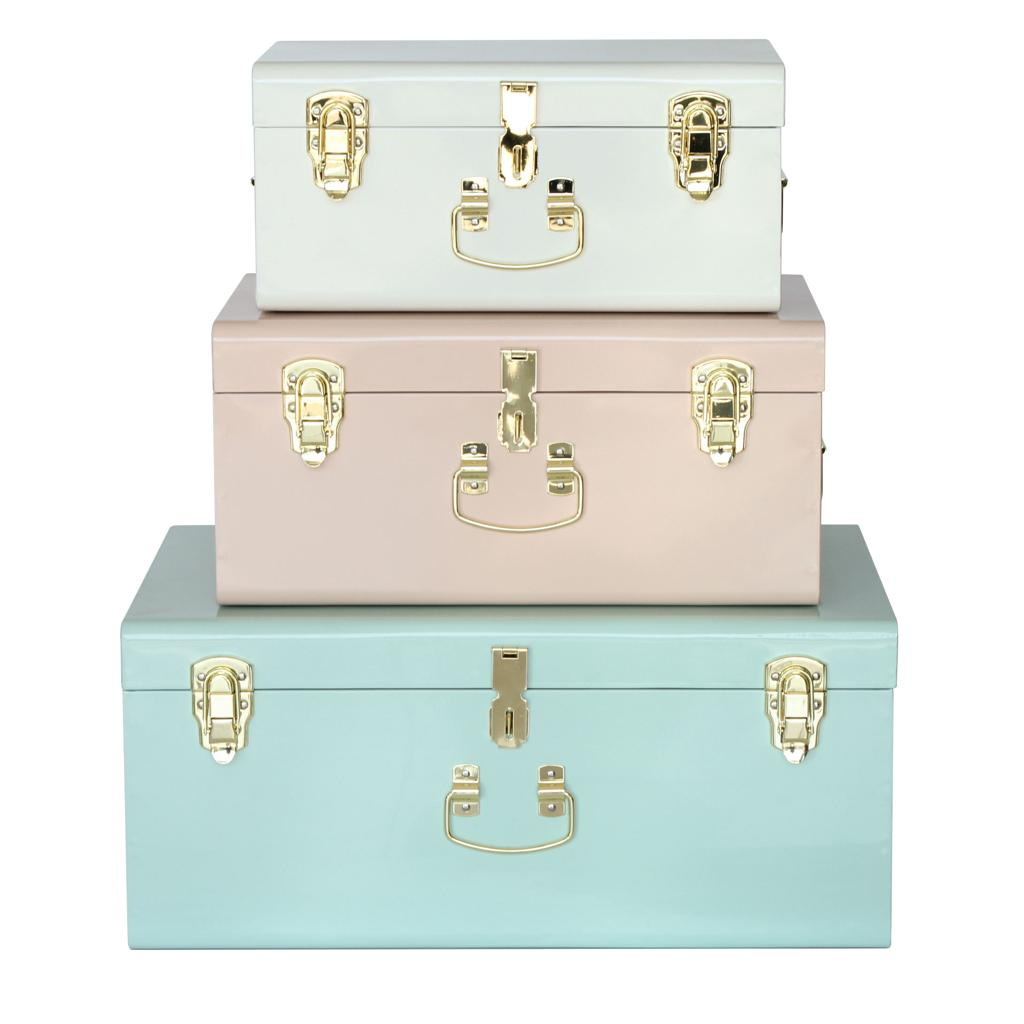
Teruier’s Pastel Three-Piece Nesting Trunk Set provides a useful starting point for discussing coordinated storage development.
The TDS27-08 collection includes three decorative trunks:
| Model | Color | Overall Dimensions |
|---|---|---|
| Small | Blush Pink | 40 × 24 × 18 cm |
| Medium | Warm White | 58 × 34 × 25 cm |
| Large | Powder Blue | 76 × 44 × 32 cm |
All three share a rectangular silhouette with rounded lid edges, vintage-style metal hardware, and front and side handle details.
From a buyer’s perspective, the development opportunity is not necessarily to create an entirely new storage product.
It may be more practical to select an existing design and identify which characteristics should remain unchanged.
For example, a private-label buyer may want to retain the three-size format while requesting different colors, revised hardware finishes, or alternative packaging.
Before approving those changes, however, the buyer and supplier must evaluate how they affect the product.
The collection’s actual nesting compatibility, structural materials, and final packaging arrangements still require confirmation.
Four Development Decisions That Affect the Finished Product
1. Dimensions Must Work With the Construction
Reducing the width of a decorative trunk is not always a straightforward adjustment.
The revised proportions may affect the position of handles, hinges, closures, internal capacity, and reinforcing components.
A buyer should request updated dimensions and construction drawings before authorizing a revised sample.
2. Decorative Hardware Must Also Function Reliably
Metal clasps, handles, and hinge assemblies contribute to the appearance of a vintage-inspired trunk.
They also introduce mechanical requirements.
For example, changing from a small decorative handle to a larger metal handle may affect its attachment method and the supporting structure.
A product that looks stronger is not automatically suitable for carrying heavier contents.
Handle strength and intended loading must be verified separately.
3. Surface Materials Affect Production and Packaging
Consider Teruier’s Powder Blue Open Storage Trunk, model TDS27-01.
Its published design includes a powder blue exterior, gold-tone hardware, and a floral lattice interior.
For a buyer requesting an alternative exterior covering, the discussion should include surface durability, edge finishing, material availability, and color consistency.
A thicker covering might require adjustments around hardware or corners. A more delicate finish might require additional packaging protection.
These are possible development considerations, not claims that such modifications have already been completed.
4. Packaging Should Be Developed Alongside the Product
A decorative trunk contains multiple areas requiring protection: corners, handles, closures, finished surfaces, and sometimes a lined interior.
Packaging decisions also influence shipping costs.
For a three-piece collection, buyers should establish whether products will be packed individually or as a coordinated set.
Physical nesting should never be assumed from the collection name alone.
Actual internal dimensions, safe packing arrangements, unit weights, carton dimensions, and the proposed shipping method should be confirmed before calculating freight efficiency.
From Product Selection to Sample Approval
Teruier has assembled more than 20 product catalogs covering several hundred home décor and accent furniture designs, supported by physical samples. Selected pieces were also presented at the October 2026 Autumn Canton Fair.
For international buyers, this provides a practical way to begin a sourcing discussion with identifiable products rather than an abstract design brief.
The process still requires a disciplined approval sequence.
| Stage | Buyer Decision | Required Evidence |
|---|---|---|
| Product selection | Which design fits the collection? | Catalog reference, model number, product images |
| Specification review | What must be retained or modified? | Dimensions, material and finish requirements |
| Sample evaluation | Does the product meet the brief? | Physical sample, measurements, inspection notes |
| Packaging approval | Can the product be protected in transit? | Packing specification and agreed validation results |
| Production authorization | Are all details finalized? | Approved reference, written specification, purchase terms |
The final approved sample should correspond to a controlled specification.
If a buyer changes the lining color, hardware, or carton arrangement after approval, that change should be documented and reviewed before production continues.
This helps reduce disputes about which version of the product was authorized.
Standard Selection vs. Private-Label Development
Not every wholesale order requires custom development.
A retailer purchasing an existing model may only need to confirm specifications, samples, pricing, quantities, and packaging.
Private-label development introduces additional responsibilities.
The buyer may require exclusive colors, branded packaging, modified construction, or a coordinated product family.
These changes can help differentiate a collection, but they can also increase sampling work, tooling requirements, or minimum order quantities.
The commercial question is whether the customization delivers enough additional value to justify its complexity.
Teruier supports custom home décor sourcing through product definition, design coordination, sampling discussions, and manufacturing resources in Fuzhou–Minhou, China.
Its role is to help buyers connect design requirements with practical manufacturing decisions rather than treat customization as a simple change of appearance.
What Buyers Should Confirm Before Wholesale Delivery
Before releasing a purchase order, buyers should confirm the approved model and revision, final dimensions, structural and exterior materials, hardware specifications, packing method, inspection criteria, quantities, agreed trade terms, and delivery schedule.
For storage products, the intended use deserves particular attention.
A decorative trunk should not be described as seating or load-bearing furniture unless the relevant construction and performance have been evaluated.
For international orders, applicable product requirements should be established for the destination market and intended use.
Frequently Asked Questions
Can Teruier develop private-label storage products from existing designs?
Buyers can discuss changes to dimensions, colors, surface finishes, hardware, and packaging. Feasibility, sampling requirements, MOQ, and costs depend on the specific product and requested modifications.
Does an approved appearance sample guarantee bulk-production consistency?
No. Visual approval should be supported by agreed materials, construction details, inspection criteria, packaging requirements, and production references.
What information should buyers send for sample development?
A useful initial brief includes the selected model or reference image, destination market, intended use, required dimensions, materials, colors, estimated quantity, packaging expectations, and target delivery requirements.
Discuss Storage Product Development With Teruier
Successful wholesale sourcing starts with a product buyers want, but it depends on specifications that manufacturers can reproduce.
Teruier works with international home décor retailers, importers, and private-label brands to review product designs, coordinate development requirements, and prepare sourcing discussions around real samples.
Explore the Teruier storage collection or contact Teruier to request product information, discuss sample modifications, and submit an RFQ for your next storage collection.