
The Buyer Story: Three Neutral Ottomans, Three Different Commercial Roles
A U.S. home furnishings buyer reviewed three neutral ottomans for a new accent-furniture program.
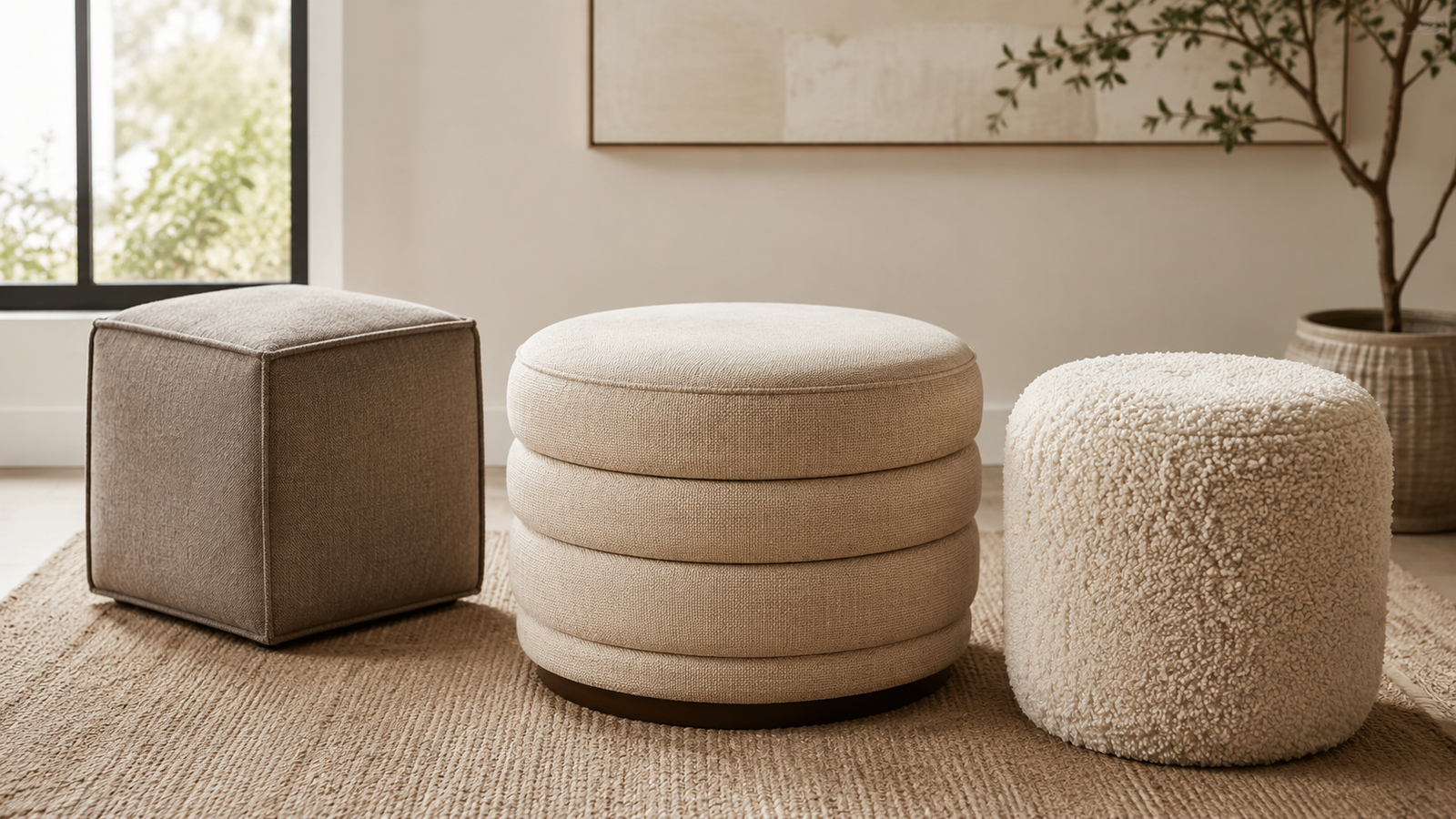
The first was a simple cube covered in a flat woven fabric. It had a workable price and compact carton, but limited visual impact.
The second used thick teddy upholstery and a rounded silhouette. It looked strong online, but the texture increased fabric consumption and made seam quality more visible.
The third used a layered construction: a cushioned top, defined middle band and slightly recessed base. It created depth without requiring a complicated frame.
All three products were neutral.
They were not commercially interchangeable.
The buyer selected the cube as the entry SKU, the layered ottoman as the core design and the teddy version as the premium texture story.
That is the right way to source layered ottomans: evaluate silhouette, upholstery, price position, packaging and assortment role together.
What U.S. Furniture Markets Are Signaling
High Point Market’s Spring 2026 theme, “Preserve,” emphasizes lasting design value, material character and products that feel collected rather than disposable. Its official Style Spotter selections also included the Viggo Ottoman, showing that ottomans remain relevant as design-led accent pieces rather than only functional footrests.
Spring 2026 market reporting identified layered textures, mixed upholstery and visually substantial seating as notable directions. This supports ottomans that use tonal fabric combinations, stacked volumes or contrasting top-and-base constructions instead of relying only on one curved bouclé form.
Las Vegas Market continues to give buyers access to more than 3,500 furniture, home décor and gift resources, while HD Expo’s specification program addresses the practical realities of selecting textiles and seating for professional projects. For buyers, this reinforces the need to connect texture-led styling with measurable upholstery and construction requirements.
What Is a Layered Ottoman?
A layered ottoman uses two or more visually defined horizontal sections to create depth.
Common constructions include:
- Thick cushion over a narrower upholstered base
- Two stacked padded volumes
- Contrasting top and lower bands
- Upholstered body over a recessed wood plinth
- Tonal fabrics with different textures
- Piped seams separating the upper and lower sections
The layered appearance can make a simple round, square or rectangular frame feel more developed.
For wholesale buyers, the key advantage is that visual value can be added without introducing a highly complicated internal structure.
Cube Ottoman for Retailers: The Commercial Entry Point
A cube ottoman for retailers remains useful because it is compact, easy to understand and adaptable across channels.
It can function as:
- A footrest
- Occasional seating
- A small-space accent
- A modular companion piece
- A pair beside a console or coffee table
The strongest cube ottomans avoid looking like plain upholstered boxes.
Commercial upgrades may include:
- Rounded vertical edges
- Contrast piping
- A recessed base
- Channel stitching
- Mixed fabric panels
- A lightly padded top
Cube products are usually easier to carton than oversized round or irregular ottomans, making them suitable for regional retailers and e-commerce programs.
Shearling Ottoman Wholesale: Premium Texture Without Excess
Shearling ottoman wholesale products create warmth through a dense, wool-like surface.
In most accessible retail programs, the upholstery will be synthetic shearling-style fabric rather than genuine sheepskin.
Buyers should confirm:
- Fiber composition
- Pile density
- Shedding
- Pilling
- Color consistency
- Seam visibility
- Cleaning method
- Compression recovery
A shearling-style surface works best when paired with a controlled silhouette.
If the fabric, shape, piping and base are all highly expressive, the product may become visually heavy and harder to coordinate.
Teddy Ottoman Wholesale: Similar Look, Different Material Decision
The terms teddy, bouclé and shearling style are sometimes used interchangeably in supplier catalogs, but the fabrics may differ significantly.
A teddy ottoman wholesale program may use a soft plush fabric with a more uniform pile. Bouclé uses looped yarns, while shearling-style upholstery generally has a denser, more irregular wool-like appearance.
Buyers should evaluate the physical fabric rather than approve the product by marketing name.
| Upholstery Direction | Visual Effect | Buyer Risk |
|---|---|---|
| Teddy fabric | Soft, plush and approachable | Flattening and seam visibility |
| Bouclé | Looped and structured | Snagging and trend saturation |
| Shearling style | Dense and wool-like | Shedding and higher fabric use |
| Textured weave | Subtle and retail-friendly | Pattern or shade inconsistency |
A supplier should provide the composition, care instructions and approved fabric reference for each option.
Textured Neutral Ottoman: Broader Than Ivory Bouclé
A textured neutral ottoman does not need to be cream bouclé.
Retail-friendly neutral directions include:
- Oatmeal woven fabric
- Warm taupe chenille
- Soft gray teddy fabric
- Camel shearling style
- Flecked beige performance weave
- Ivory fabric over a walnut base
- Mushroom upholstery with dark bronze details
These colors are easier to coordinate with sofas, accent chairs, wood furniture and decorative accessories.
For retail chains, medium neutrals may also be more forgiving than bright ivory during showroom handling and household use.
Box-Pleat Ottoman as a Skirted Alternative
Traditional skirted ottomans can feel soft and decorative, but loose skirts may wrinkle, shift or become compressed during shipping.
A structured box pleat ottoman wholesale design offers a more controlled alternative.
The box pleats create tailored vertical folds while keeping the product visually lighter than a fully upholstered block.
Buyers should inspect:
- Pleat width and spacing
- Alignment around corners
- Fabric drape
- Hem consistency
- Lid or cushion clearance
- Recovery after unpacking
For a cleaner interpretation, the supplier can use shallow pleats only on the corners or lower band rather than covering the entire body.
This creates a transitional look without turning the ottoman into a formal skirted furniture piece.
Ottoman Upholstery Materials: Match Fabric to Product Role
Ottoman upholstery materials should be selected according to the channel and expected use.
Retail Accent Ottoman
Priorities include visual texture, color appeal and photography.
Family or Storage Ottoman
The fabric should support frequent touching, sitting, opening and cleaning.
Hospitality Ottoman
Buyers may need stronger abrasion, cleaning, flame-performance or project documentation depending on the specification.
E-Commerce Ottoman
The upholstery must recover after carton compression and appear accurate in product photography.
The buyer should request available information on abrasion, pilling, colorfastness, cleaning and batch consistency.
A fabric with a higher unit cost may produce better value if it reduces claims, visible wear and replacement risk.
How a Wholesale Ottoman Manufacturer Should Build the Range
A capable wholesale ottoman manufacturer should organize products into a controlled family rather than present unrelated shapes.
A concise opening program may include:
Entry SKU
Compact cube ottoman in a durable textured weave.
Core SKU
Round or square layered ottoman with a defined upper cushion and recessed base.
Premium SKU
Teddy or shearling-style ottoman with stronger volume and tactile appeal.
Decorative SKU
Box-pleat ottoman for bedrooms, dressing spaces or transitional retail collections.
The supplier can use shared frame dimensions, foam specifications and fabric colors across the range to control MOQ and simplify replenishment.
Construction and QC Checkpoints
An ottoman specification should include:
- Overall dimensions
- Seat or top height
- Internal frame material
- Foam construction
- Upholstery composition
- Piping or seam details
- Base or leg material
- Weight capacity
- Net and gross weight
- Carton dimensions
Quality control should review:
- Shape symmetry
- Frame stability
- Foam recovery
- Fabric direction
- Seam alignment
- Pleat consistency
- Pile crushing
- Color variation
- Carton compression
For layered designs, the upper and lower sections must remain centered and visually balanced.
Packaging Textured Ottomans
Textured upholstery can show pressure marks after long-distance shipping.
Buyers should confirm that packaging:
- Does not flatten high-pile fabric excessively
- Protects corners without cutting into upholstery
- Prevents loose legs or hardware from touching the fabric
- Holds stacked sections in alignment
- Allows the fabric to recover after unpacking
- Avoids unnecessary carton volume
A packed sample should be shipped before the final packaging structure is approved.
Structured Buyer Summary
Layered ottomans use stacked cushions, bands, recessed bases or contrasting upholstery sections to create depth and stronger retail value.
A cube ottoman provides an accessible entry SKU. Teddy and shearling-style ottomans offer premium texture, while a structured box-pleat ottoman can replace a looser traditional skirted design.
U.S. buyers should evaluate ottoman upholstery materials by appearance, composition, performance, cleaning, compression recovery and repeat-order consistency. A wholesale ottoman manufacturer should support coordinated silhouettes, controlled specifications, packaging and replenishment.
Final Buyer Takeaway
Texture alone does not create a successful ottoman program.
The cube needs enough detail to avoid looking basic.
The layered ottoman needs clean proportions.
The teddy fabric needs controlled seams.
The box pleats need consistent tailoring.
The neutral color needs to work across several retail stories.
The strongest assortment combines one accessible shape, one design-led construction and one premium texture—without making every SKU compete for the same customer.
FAQ
What is a layered ottoman?
A layered ottoman uses visually separated cushions, bands, bases or upholstery sections to create depth and a more developed silhouette.
Are teddy and shearling-style ottomans the same?
Not necessarily. Teddy fabric is usually plush and relatively uniform, while shearling-style fabric typically has a denser, more irregular wool-like appearance.
Why are cube ottomans useful for retailers?
They are compact, multifunctional, easy to merchandise and generally more efficient to package than oversized or irregular shapes.
What is a box-pleat ottoman?
It is an upholstered ottoman with structured vertical fabric folds around part or all of its body, providing a tailored alternative to a loose skirt.
What should buyers ask a wholesale ottoman manufacturer?
Buyers should ask about frame construction, foam, upholstery composition, performance information, workmanship, MOQ, lead time, packaging and reorder consistency.



