A hotel project may need dozens or hundreds of mirrors, but that does not mean every mirror should be custom-made—or that every room should use the same model.
For project buyers, the real challenge is deciding where a distinctive design creates value and where a standardized product makes procurement easier.
A lobby mirror may contribute to the property’s identity. A guest-room mirror must fit the furniture layout and installation requirements. A mirror in a repeated room type needs consistent dimensions, finishes, and mounting details across multiple units.
For buyers working with a custom mirror manufacturer, the goal is to create a coordinated specification that respects both the interior design and the project’s commercial constraints.
One Hotel, Three Different Mirror Requirements
Imagine a boutique hotel with a feature wall in the entrance, repeated guest rooms, and several corridor areas.
The interior designer wants a consistent visual language, but the procurement team must manage cost, production, installation, and future replacement.
Using one expensive custom mirror throughout the property may be unnecessary. Selecting the cheapest standard mirror for every location may weaken the design.
A more practical approach is to divide the project into three procurement roles.
| Project Area | Procurement Priority | Recommended Approach |
|---|---|---|
| Lobby and signature areas | Strong visual identity | Consider a distinctive, project-specific mirror |
| Repeated guest rooms | Consistency and manageable cost | Standardize an approved model across room types |
| Corridors and secondary areas | Functional fit and easy coordination | Use a repeatable specification suited to the wall and surrounding furniture |
These are planning principles rather than universal rules. The final selection depends on the design brief, room layouts, budget, and applicable technical requirements.
Standardize the Specification, Not Necessarily the Appearance
Standardization is often misunderstood as using identical products everywhere.
In practice, a project can maintain one design language while using different mirror models for different functions.
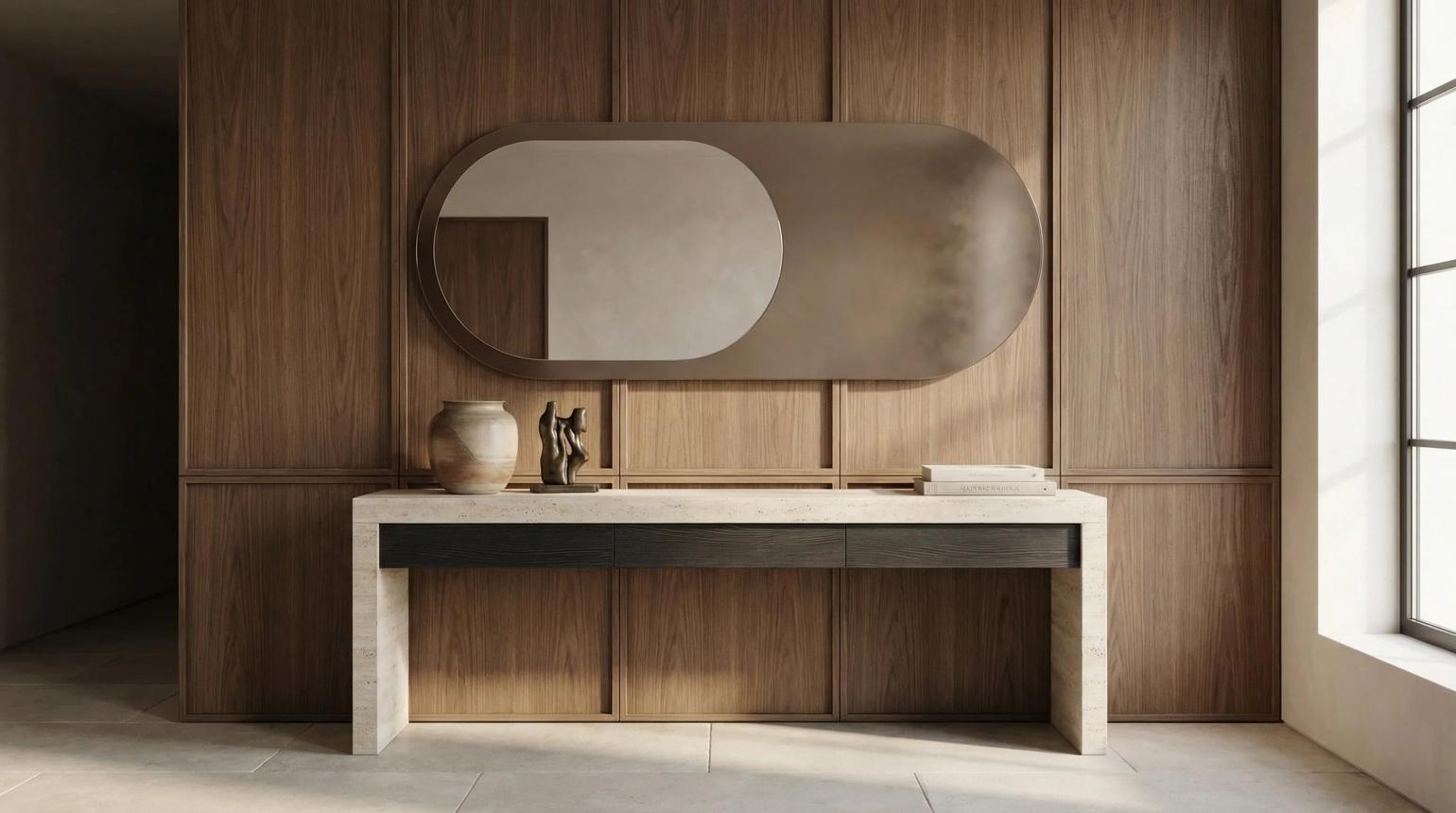
For example, the project may specify a consistent warm-neutral palette, controlled frame proportions, and similar surface finishes. A feature wall can then use a more architectural mirror, while guest rooms use a simpler horizontal design.
This approach can reduce unnecessary variation without making the entire property look repetitive.
The important distinction is between visual consistency and identical product selection.
A good project specification defines which characteristics must remain consistent and which can change according to location.
Two Teruier Mirror Designs, Two Procurement Roles
Teruier’s existing catalog provides two examples of how different mirror constructions can serve different project requirements.
1. Quiet Mineral Reveal Mirror — TMR27-H08
The Quiet Mineral Reveal Mirror is an architectural-style wall mirror designed for hospitality interiors.
Its published reference specification includes:
- Overall size: 800 × 1,000 × 36 mm
- Mirror: 4 mm silver mirror glass
- Surround: warm-gray mineral composite finish
- Surround width: 52 mm on all four sides
- Recessed mirror surface: approximately 10–12 mm
- Installation: wall-mounted
- Lighting: none
The recessed glass creates a shadow line around the mirror without requiring integrated LED lighting.
For a project buyer, this offers an alternative to a conventional metal-framed mirror when the design calls for a quieter architectural appearance.
It may be considered for guest-room entrances, corridors, suites, and common areas, subject to the actual wall elevation and project requirements.
The published page also states that dimensions, mineral finishes, mounting solutions, and project packaging can be reviewed against approved requirements.
2. Reeded Oak Horizontal Mirror — TMR27-NS09
The Reeded Oak Horizontal Mirror offers a different design approach.
Its published specifications include:
- Reference size: 1,000 × 650 × 28 mm
- Alternative size: 800 × 520 × 28 mm
- Frame material: engineered wood with light oak veneer
- Finish: natural matte light oak
- Installation: horizontal, wall-mounted
- Design feature: a sculptural, reeded section on the left side
Its horizontal proportions make it a potential option above hotel desks, bedroom cabinets, consoles, or vanity areas.
Unlike the mineral-surround design, it introduces a natural wood appearance and a more decorative frame detail.
For a buyer, the difference is not simply which mirror looks better. It is which construction suits the wall, furniture dimensions, interior palette, and intended project budget.
Both models provide a starting point for specification discussions, not an automatic approval for every hotel application.
The Project Mirror Schedule: What Must Be Decided Before Ordering?
A quotation is only as reliable as the specification behind it.
For B2B home furnishings sourcing, project buyers should prepare a mirror schedule that identifies the requirements for each location before requesting comparable quotations.
The schedule should include:
- Location and quantity: Room type, installation area, and number of units.
- Dimensions and orientation: Overall width, height, depth, and any dimensional tolerances.
- Design and finish: Frame material, surface treatment, color reference, and approved sample.
- Installation: Mounting method, fixing points, wall construction, and responsibility for site installation.
- Glass requirements: Glass specification, edge treatment, and any required safety backing or other project-specific provisions.
- Electrical requirements: Whether lighting is required or a non-illuminated mirror is preferred.
- Packaging and logistics: Carton dimensions, protection requirements, labeling, and delivery sequence.
- Approval status: Reference drawings, sample approval, revisions, and the final specification version.
Bathroom mirrors require additional attention to moisture exposure, installation location, materials, and relevant local requirements. A mirror designed primarily for guest-room entrances or corridors should not automatically be approved for a wet environment.
This schedule helps the procurement team compare quotations against the same requirements instead of comparing products that only look similar in photographs.
Where Should the Project Spend More?
Not every location deserves the same customization budget.
A practical approach is to divide products into three levels.
| Level | Product Strategy | Commercial Objective |
|---|---|---|
| Level 1: Standard | Existing model with established specifications | Simplify repeat purchasing |
| Level 2: Adapted | Existing design with adjusted dimensions or finish | Fit the project without unnecessary redesign |
| Level 3: Bespoke | New design or specialized construction | Create a distinctive focal point where it matters |
The highest level is not automatically the best choice.
A bespoke mirror may improve a feature wall, but custom dimensions can affect drawings, sample development, mounting details, packaging, and production planning.
An existing model may already satisfy the design intent with fewer development steps.
For supplier evaluation, buyers should ask what the proposed customization actually changes and whether that change justifies its additional cost and complexity.
The answer should be based on the project rather than a general promise that everything can be customized.
The Sample Approval That Protects the Entire Project
For repeated installations, approving one attractive sample is not enough.
The buyer should establish which characteristics are critical to reproduce across the order.
These may include overall dimensions, frame proportions, finish tone, surface texture, glass appearance, mounting points, and packaging configuration.
The approved sample and its associated drawings should be treated as the reference for production.
If a change becomes necessary, it should be reviewed and documented before the revised specification is used for manufacturing.
For projects with multiple room types, it is also important to identify which approved model belongs to which location. This prevents a visually similar alternative from being installed where a specific design was required.
A disciplined approval process does not eliminate every production risk, but it makes the intended result clearer and easier to verify.
Plan for Replacement Before the Hotel Opens
Project procurement should consider the property’s operating life, not only the opening date.
A damaged mirror may need to be replaced months or years after installation. If the original dimensions, finish references, model identification, and mounting details were not retained, matching the existing installation can become difficult.
Buyers should therefore keep a record of:
- The final model and approved specifications.
- The finish and material references.
- The mounting and installation details.
- The final product drawings.
- The supplier’s ability to quote replacement units or future variations.
This is particularly useful for projects with repeated room layouts.
Where possible, standardized dimensions and clearly identified models can make future replacement easier. However, long-term availability should be confirmed rather than assumed.
What to Send a Custom Mirror Manufacturer
Before requesting a project quotation, buyers should prepare a concise package containing the intended application, room elevations, target dimensions, quantities by location, preferred materials and finishes, installation conditions, destination market, and project schedule.
It is also useful to identify which requirements are fixed and which remain open to recommendation.
For example, the designer may insist on a particular outer dimension but allow the supplier to propose an appropriate frame construction.
Clear boundaries help the supplier evaluate feasibility without changing the design intent unnecessarily.
Teruier’s existing mirror specifications and product-development options provide a starting point for these discussions. The final material configuration, technical requirements, sample plan, and commercial terms must be confirmed for the selected model.
FAQ
Should every room in a hotel use the same mirror?
Not necessarily. Repeated room types often benefit from standardized models, while lobbies and other signature spaces may justify distinctive designs. The decision should follow the interior brief, budget, and installation requirements.
Is a custom mirror always more expensive than a standard model?
Not in every case, but customization may introduce additional sampling, engineering, tooling, or production costs. Buyers should compare the complete quotation and development requirements rather than assume a fixed cost difference.
What is the most important information to provide before requesting a project quotation?
Start with location-specific quantities, dimensions, wall elevations, finish requirements, mounting conditions, target market, and delivery schedule. These details help the supplier determine whether an existing model is suitable or further development is needed.
Discuss Your Hotel Mirror Requirements With Teruier
A successful mirror specification balances design identity with repeatability, installation practicality, and long-term operating needs.
Teruier works with international buyers on decorative and architectural-style mirrors, product specifications, sampling, and project-related sourcing discussions.
Contact Teruier with your project drawings, target quantities, preferred finishes, and installation requirements to discuss suitable models and quotation options.