Ceramic Decor with Meaning: From Craft Story to Commercial Collection
The latest European design discussion has moved away from producing more objects simply because another shelf remains available.
Recent fairs have placed greater emphasis on meaningful objects, authentic textures, craftsmanship and products that create a stronger emotional connection with the customer.
For ceramic décor, this is encouraging.
It suggests that a vase may once again be appreciated for its form, surface and making—not merely because somebody has painted it beige and called it “quiet luxury”.
For German buyers, however, meaning must survive commercial reality.
A handcrafted surface must still be repeatable. An expressive glaze must remain within an acceptable colour range. A sculptural vessel must fit a shelf, a carton and preferably the customer’s home.
The Teruier German Channel examines this point where craftsmanship meets practical buying.
What Is Ceramic Decor?
Ceramic décor refers to decorative objects formed from clay-based materials and hardened through firing.
The category may include:
- Vases and decorative vessels
- Planters and cachepots
- Bowls and centrepieces
- Candle holders
- Sculptural objects
- Lidded jars
- Decorative trays
- Wall-mounted ceramics
- Seasonal ornaments
Some ceramic products are functional. Others are designed primarily for decoration.
The distinction should be clear.
A vessel that looks like a vase will eventually receive water, no matter how confidently the packaging describes it as an “art object”.
What Does the German Channel Look for in Ceramic Decor?
The Teruier German Channel does not treat ceramic décor as a collection of attractive glaze photographs.
It examines the complete product proposition:
- Shape and proportion
- Clay body and product weight
- Glaze character
- Colour consistency
- Surface texture
- Intended function
- Production tolerances
- Packaging and breakage risk
- Retail positioning
- Collection potential
For German buyers, these elements matter because customers usually expect decorative value and practical credibility to exist at the same time.
A vase may be artisanal.
Its base should still be level.
Craft Character Versus Production Control
Ceramic décor is attractive partly because it does not look mechanically perfect.
Reactive glazes, hand-applied details and firing variation can give every piece a slightly individual character.
This does not mean that anything emerging from the kiln should be celebrated as unique.
| Controlled Craft Character | Uncontrolled Variation |
|---|---|
| Differences remain within an agreed range | Colours change noticeably between pieces |
| Glaze movement supports the design | Bare patches appear randomly |
| Handmade detail looks intentional | Finish appears incomplete |
| Shape remains stable and usable | Product leans or deforms |
| Customers understand the variation | Customers believe they received the wrong item |
Variation can increase perceived value.
Lack of control increases return rates.
The difference is not philosophical. It is measurable.
Why a Home of Crafts Matters
Teruier works with the production knowledge found in established Chinese homes of crafts.
A craft-producing region offers more than a convenient concentration of factories. It contains accumulated knowledge shared across workshops, material suppliers, technicians and skilled workers.
This knowledge helps answer practical questions:
- Which shapes are likely to deform during firing?
- Which glaze works with a particular clay body?
- How much colour variation should be expected?
- Which handmade effects can be standardised?
- Where can weight be reduced safely?
- How should irregular surfaces be protected in transit?
A designer may draw an elegant organic form in ten minutes.
The local ceramic technician may spend considerably longer explaining why gravity, clay shrinkage and kiln temperature were not included in the sketch.
This is where craft knowledge creates commercial value.
Decorative Ceramic Versus Functional Ceramic
| Consideration | Decorative Ceramic | Functional Ceramic |
|---|---|---|
| Primary purpose | Visual impact and atmosphere | Practical use plus appearance |
| Main buying focus | Shape, colour, texture and display | Performance, cleaning and suitability |
| Water resistance | May not be required | Often essential |
| Dimensional control | Allows some artistic freedom | Usually requires tighter tolerances |
| Testing requirements | Depends on intended use | May include food-contact or water tests |
| Customer expectation | Character and decoration | Reliable repeated use |
The two categories may look similar, but they should not be specified in the same way.
A decorative bowl is not automatically suitable for food.
A planter is not automatically waterproof.
A candle holder is not automatically heat-safe simply because a candle fits inside it.
Product shape often encourages customer behaviour. Specifications should therefore be clearer than customer optimism.
From One Vase to a Commercial Collection
One strong ceramic product may attract attention.
A coordinated collection creates more commercial possibilities.
A collection can be developed through:
- Related silhouettes
- Several practical sizes
- Shared glaze families
- Repeated decorative motifs
- Coordinated matte and glossy surfaces
- Different products using the same visual language
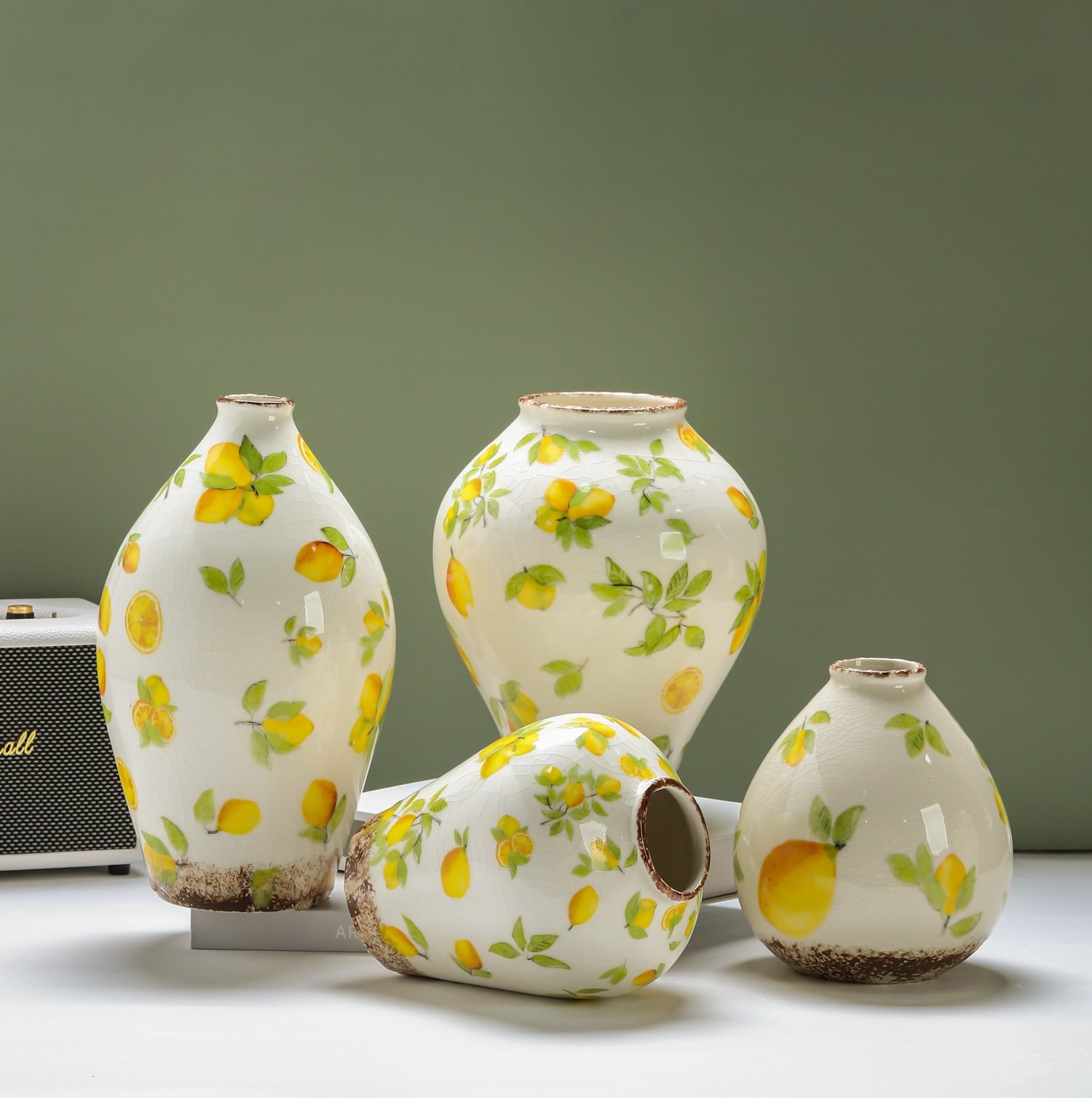
For example, a rounded ceramic vase may be extended into a smaller vessel, a planter and a candle holder.
The forms do not need to be identical. They should appear related enough to support cross-selling and coherent display.
Ten unrelated objects in the same colour are not necessarily a collection.
Sometimes they are simply ten unrelated objects wearing the same coat.
What Creates Retail Value?
Ceramic value should be visible.
Customers may recognise value through:
- A distinctive silhouette
- A tactile glaze
- A carefully finished rim
- A convincing scale
- A rich colour
- A handmade detail
- A coordinated product family
Added cost should create an improvement the customer can see or feel.
A complicated firing process may be technically impressive. If the finished product looks identical to a cheaper alternative, the production story has failed to reach the shelf.
The German Channel therefore translates craft and production details into buyer questions:
What does this process improve?
Will the customer notice?
Can production repeat it?
Does the retail price remain credible?
Why Ceramic Decor Belongs in the German Channel
Ceramic décor sits between art, craft and commercial home decoration.
This makes it a useful category for examining the wider position of the Teruier German Channel.
The channel stands for:
- Design interpretation rather than trend repetition
- Category knowledge rather than catalogue volume
- Controlled craftsmanship rather than vague artisan language
- Product consistency rather than sample theatre
- Customer value rather than unnecessary complexity
The objective is not to remove the personality of ceramics.
The objective is to ensure that personality can be ordered again.
Frequently Asked Questions
What is a reactive glaze?
A reactive glaze changes through chemical reactions during firing, creating variations in colour and surface. Buyers should agree on an acceptable visual range before production.
Does handmade always mean higher quality?
No. Handmade production may create character, but quality depends on skill, process control and suitability for the intended market.
Are decorative vases watertight?
Not always. Watertightness should be confirmed through specifications and testing.
Why do ceramic colours vary between batches?
Clay composition, glaze thickness, kiln temperature and firing position can all influence the result.
Can ceramic décor be developed for German volume retail?
Yes, provided the design, variation, price, packaging and quality standards are suitable for repeatable production.
Is heavier ceramic more valuable?
Not necessarily. Weight can create a feeling of substance, but excessive weight increases freight and handling costs. A vase should not require a risk assessment before being moved.
How should buyers evaluate a ceramic sample?
Check the silhouette, base stability, glaze coverage, colour range, rim quality, internal finish, intended function and packaging.
Craftsmanship Must Be Visible—and Manageable
European design fairs are encouraging a renewed appreciation of objects with character, provenance and meaning.
For ceramic décor, this creates an opportunity.
But German buyers do not need craft stories separated from product facts.
They need meaningful form, controlled variation, credible retail value and production that remains reliable after the sample room.
The Teruier German Channel connects these elements.
Because the best ceramic objects should look individual.
The purchase order should not feel experimental.