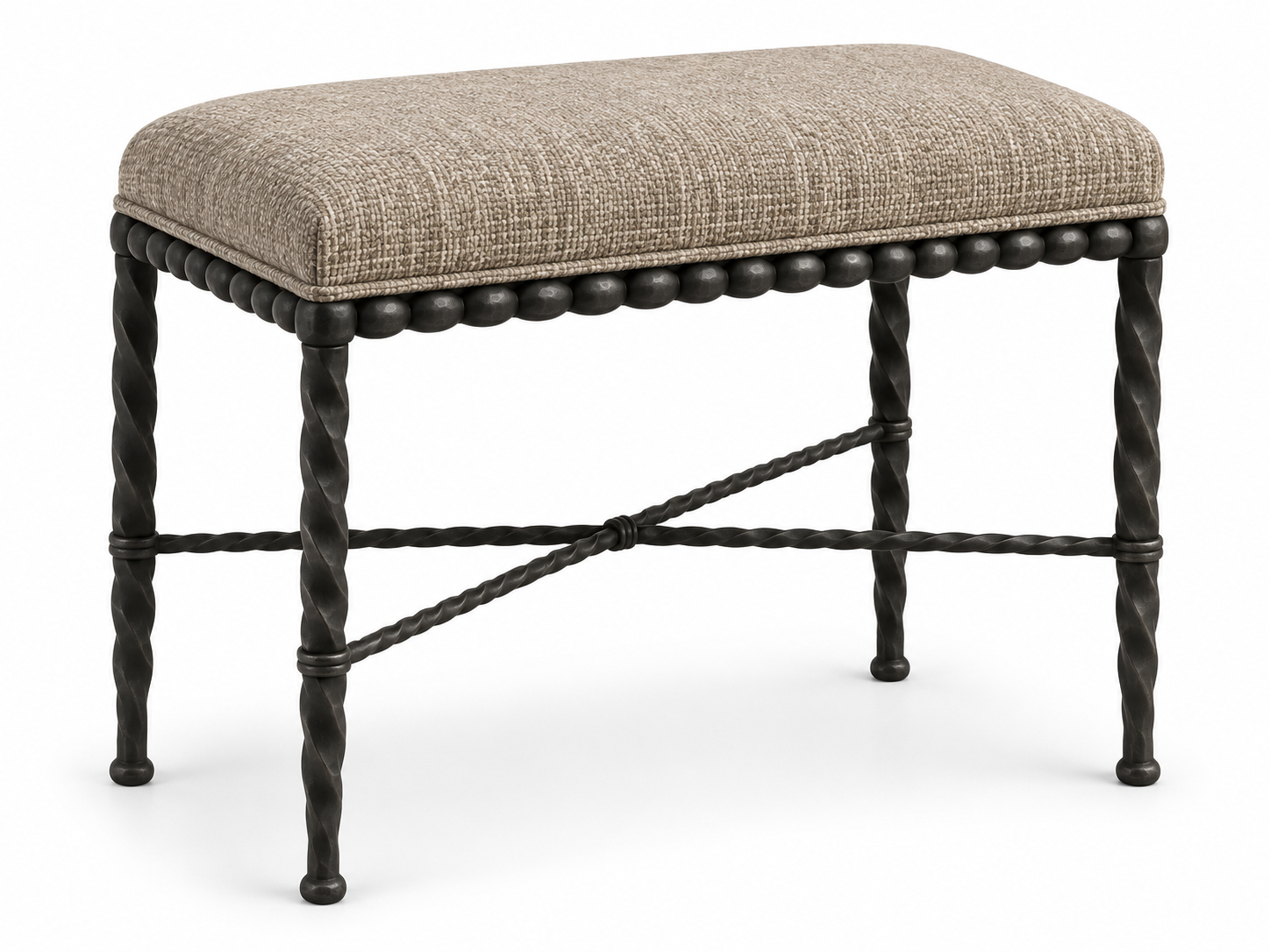
Take an ordinary upholstered stool.
Replace its gold legs with black ones.
Add a slightly distressed finish.
Call it vintage industrial.
Done?
Not quite.
This is one of the easiest mistakes to make in accent furniture development: confusing a colour change with a genuine design transformation.
For retail buyers working with a wholesale ottoman supplier, the distinction matters. A new finish can refresh a product, but it does not necessarily give customers a convincing reason to choose it over similar stools already on the market.
A black frame is a specification. Vintage industrial is a design language.
They are not the same thing.
A Black Frame Can Belong to Completely Different Styles
Consider Teruier’s 23T207 Bouclé Vanity Bench Stool.
It combines a soft bouclé-style upholstered seat with a curved matte-black metal frame.
The product has a clean, contemporary appearance. Its open structure creates visual lightness, while the soft upholstery keeps it suitable for modern bedrooms, dressing areas and compact interiors.
Now consider the 23T209 Bouclé Accent Ottoman Stool.
This model pairs a rounded cream-coloured upholstered body with gold-tone metal legs.
The different base finish affects the visual character, but these two products also differ in proportions, upholstery volume and frame geometry.
Simply painting both bases black would not make them members of the same vintage-industrial collection.
To create a distinct style, the design team must examine how the entire product communicates its identity.
Industrial Character Comes From Construction, Not Just Colour
Vintage-industrial furniture can draw on the visual language of utilitarian metalwork, exposed structure, workshop craftsmanship and furniture developed for practical use.
But that language does not require every product to look heavy, rough or mechanically complicated.
In fact, a slender metal frame can create a stronger impression when its structure is carefully resolved.
Consider three possible base designs.
| Frame Direction | Visual Character | Development Consideration |
|---|---|---|
| Simple straight legs | Minimal and versatile | Proportions, joints and visual weight |
| Slender legs with cross-bracing | More architectural and workshop-inspired | Connection design and structural requirements |
| Curved forged-look supports | More artisanal and expressive | Repeatable shaping and finish control |
None is automatically superior.
A basic four-leg frame can work beautifully when its proportions are right.
Cross-bracing can add visual interest and, depending on the engineered structure, provide reinforcement. But a poorly placed brace may complicate access, cleaning or manufacturing.
A circular footrest may suit a taller stool, while adding it to a low accent stool can be visually unnecessary.
Good industrial design does not mean adding more metal. It means giving the metal a clear purpose.
The Problem With Heavy Legs on Small Upholstered Stools
Buyers should pay attention to the relationship between seat volume and frame thickness.
A compact upholstered seat supported by visually heavy legs can appear awkward.
The frame competes with the cushion rather than supporting its shape.
But reducing leg thickness without reviewing construction creates another problem.
A slimmer frame may need different joint geometry, material specifications, reinforcement or support arrangements.
The objective is not to make legs as thin as possible.
It is to achieve a convincing balance between visual lightness and verified structural performance.
For a vintage-industrial accent stool, the strongest impression may come from a relatively soft upholstered top supported by disciplined, slender black metalwork.
That contrast creates character without requiring excessive ornament.
Hammered Texture Is Not the Same as Random Distressing
Surface treatment is another area where styling shortcuts can undermine a product.
A supplier may add scratches, uneven colour or artificial ageing to create a vintage effect.
But uncontrolled distressing can make the product look inconsistent or poorly finished.
A considered metal finish should have a defined visual reference.
Possible directions include a restrained hammered texture, brushed metal character, low-sheen black coating or carefully controlled antiquing.
These effects should not be treated as interchangeable.
A genuine hand-worked finish, a mechanically applied texture and a decorative coating may produce different results and involve different production methods.
Buyers should ask exactly which process is being used.
The approved sample should establish the intended texture, sheen and acceptable variation.
Craft character should be intentional. Manufacturing defects should not be renamed craftsmanship.
A beautiful first sample is only useful if production can reproduce the agreed result.
The Upholstery Must Belong to the Same Design Story
Metal is only half the stool.
The upholstered seat can reinforce the design direction—or contradict it.
For example, consider these proposed combinations:
| Black Metal Frame | Upholstery Direction | Intended Visual Effect |
|---|---|---|
| Slim forged-look legs | Natural linen-look fabric | Relaxed, understated vintage character |
| Curved black supports | Suede-look upholstery | Softer, more tactile industrial expression |
| Fine cross-braced frame | Leather-look upholstery | Structured, workshop-inspired appearance |
| Simple four-leg base | Textured woven fabric | More accessible transitional styling |
These are design directions, not claims that the materials have already been approved for production.
Actual fabric composition, durability, care requirements and production feasibility must be confirmed during sampling.
The important point is that upholstery should not be selected independently from the metal frame.
A heavily distressed leather-look seat with ornate legs may create one type of character.
A restrained linen-look seat on fine black ironwork can create a very different result.
Both may work, but they should not automatically be described as the same collection.
Teruier’s article From Fabric Swatches to a Coordinated Accent Seating Collection explains why upholstery decisions should be considered alongside product forms and shared finish directions.
A Development Exercise: Five Stools, One New Design Language
Consider a practical development brief.
Five existing upholstered stool forms need to be reinterpreted into a coordinated vintage-industrial seating range.
The temptation is to give all five black legs and use the same distressed fabric.
That would create visual similarity, but not necessarily a convincing collection.
A better approach is to establish a few common design rules:
One metal language: controlled black finishes with agreed texture and sheen.
A consistent sense of proportion: relatively fine frames, with each model’s structural requirements properly evaluated.
A limited set of construction details: cross-bracing, curved supports or simple metalwork selected where they improve the design.
A coordinated upholstery palette: fabrics that create material depth without making every seat identical.
Different product roles: each stool should have its own silhouette and intended retail application.
This is a proposed development method, not a claim that every model has been physically tested or released.
The collection becomes recognizable because the products share design principles, rather than because they have all been painted the same colour.
What Should Buyers Ask Before Approving the New Style?
A buyer reviewing a proposed vintage-industrial stool should separate appearance from technical approval.
The design review should ask whether the frame proportions, metal texture, upholstery and construction details form a coherent product.
The technical review should confirm material specifications, welds and joints, stability, intended use, relevant performance requirements, floor protection and packaging.
The commercial review should consider whether the new design has a meaningful difference from existing products and whether that difference justifies its expected retail position.
The comparison must be made using approved samples and specifications, not just renderings.
Teruier’s Beyond the Product Photo: Reviewing Upholstered Stools in Person demonstrates how physical sample review helps buyers judge scale, materials and proportions more accurately.
For a structured approach to documentation, see Home Decor Spec Sheets: Where Pretty Products Go to Become Real Business.
What Teruier Brings to Stool and Ottoman Development
Teruier works with international buyers on upholstered stools, ottomans, benches and decorative accent furniture through its product-development and manufacturing resources in Fuzhou–Minhou, China.
Its existing Stool Collection provides product references for exploring different upholstered forms and base designs.
For buyers developing a new vintage-industrial direction, the discussion can begin with existing models and a more specific design brief.
The development process may involve reviewing seat proportions, metal frame geometry, proposed finishes, upholstery options, sample adjustments and manufacturing feasibility.
The purpose is not to claim that every design can become a commercial product through a simple cosmetic modification.
It is to identify which changes genuinely improve the product’s visual identity while remaining practical to manufacture and supply.
FAQ
Does a black metal frame automatically make a stool industrial?
No. A black frame can be used in contemporary, minimalist, transitional or industrial-inspired furniture. Overall structure, proportions, material treatment and detailing determine the visual character.
Are slimmer metal legs always better?
No. Slimmer legs may create a lighter appearance, but structural suitability depends on the complete design, material, connections and intended use.
Can vintage-industrial stools use fabric upholstery?
Yes. Woven fabrics, linen-look materials, suede-look surfaces and leather-look upholstery can all support different industrial-inspired designs. Materials should be selected according to appearance, performance and manufacturing requirements.
Is an aged metal finish the same as hand-forged metal?
No. A distressed decorative coating does not prove that the metal was hand-forged. Suppliers should describe the actual process accurately.
Can an existing ottoman or stool be redesigned into a new collection?
Potentially. Buyers can discuss changes to frame geometry, upholstery, finishes and details. The feasibility and performance of the revised product must be confirmed through appropriate development and testing.
Stop Buying a Colour Change. Start Buying a Design Decision.
A black finish is easy to request.
A convincing vintage-industrial stool takes more thought.
The buyer should be able to explain why the legs have a particular shape, why the seat uses a particular material, why the metal texture looks intentional and why the complete product deserves a place in the collection.
Teruier welcomes international retailers, importers and home furnishings brands interested in upholstered stool development, metal-frame customization and coordinated accent seating collections.
Contact Teruier to discuss your product references, preferred metal finishes, upholstery materials and sample-development requirements.
Because a new colour can change how a stool looks. A new design language changes what the stool is.