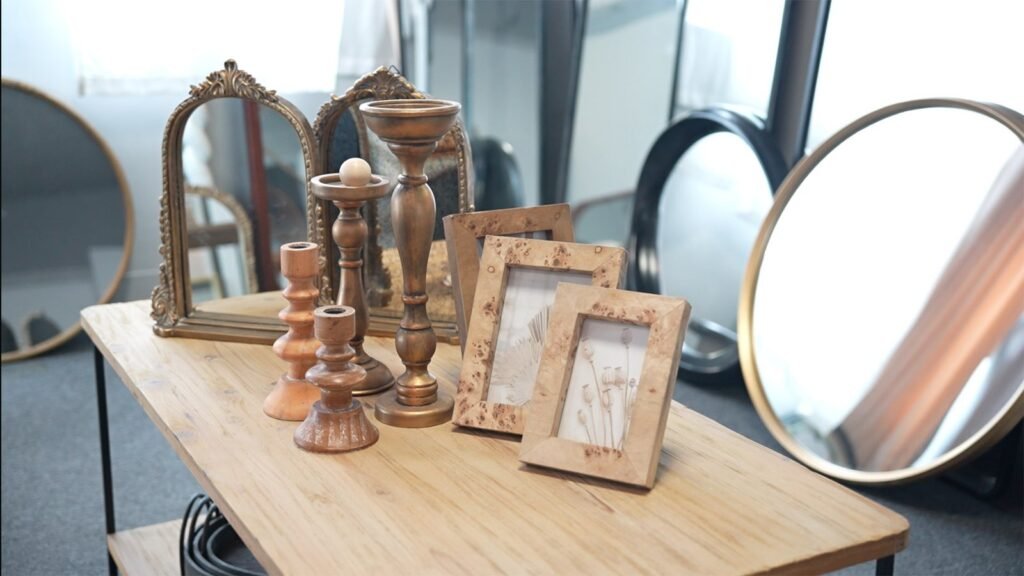
For U.S. home décor retailers, textured wall mirrors and ornate gold mirrors serve different merchandising needs. Textured frames can introduce warmth and visual depth into casual or organic-inspired collections, while ornate gold designs can create a stronger focal point for traditional, vintage, or decorative interiors.
For buyers sourcing wholesale decorative mirrors, neither style is automatically the better investment. The decision depends on target customers, product positioning, frame construction, retail presentation, and shipping requirements.
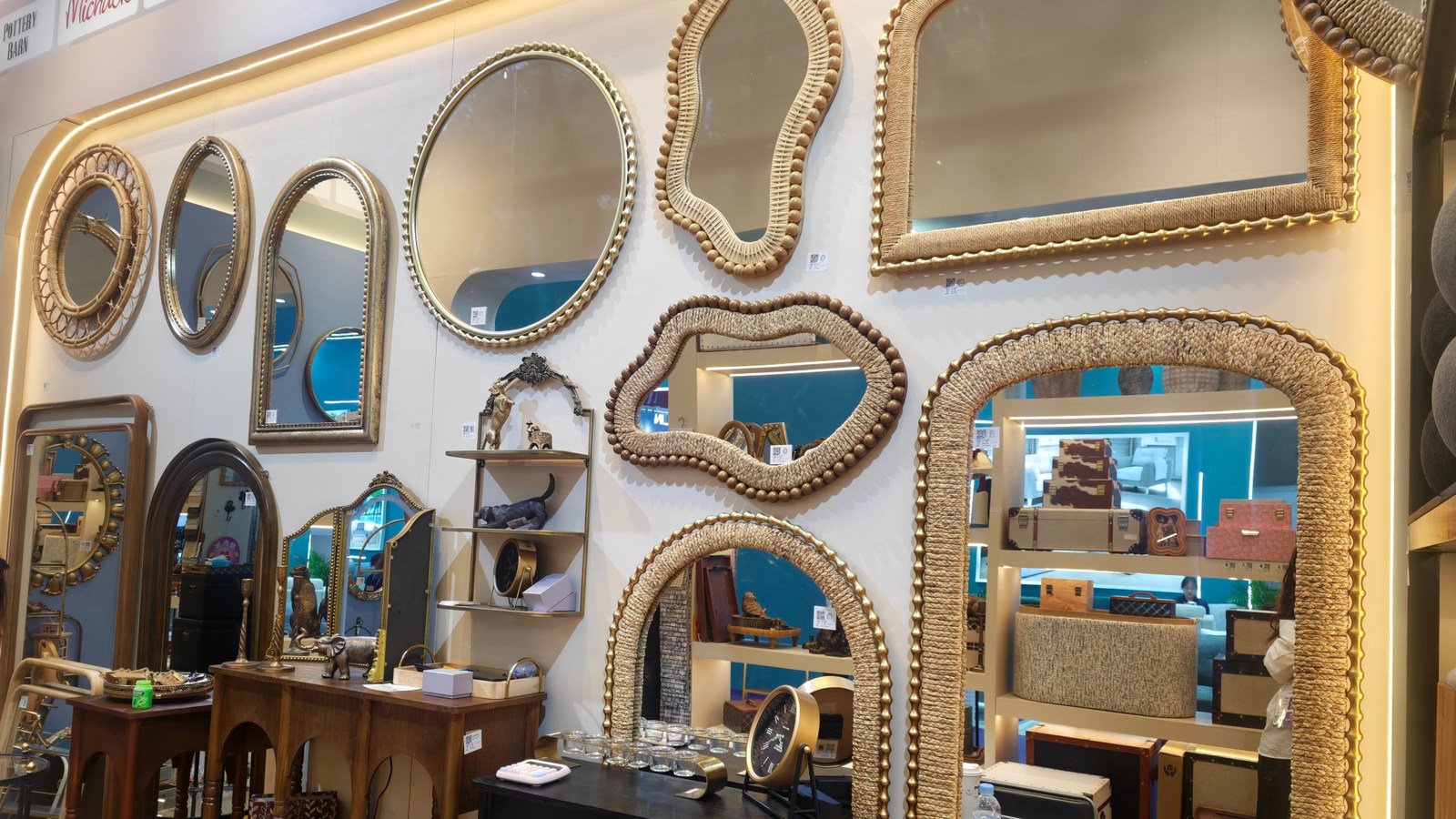
At the 2026 Autumn Canton Fair, Teruier displayed both directions alongside a broader collection of decorative mirrors, giving buyers an opportunity to compare real products rather than relying only on catalog images.
Why Texture and Ornamental Gold Both Matter
Recent U.S. home furnishings presentations suggest that natural-looking textures and decorative metallic finishes can coexist.
A September 2026 High Point Market mirror preview featured both woven-frame designs and sculptural gold-tone mirrors.
For retail buyers, the useful takeaway is not that one style will replace the other.
Instead, these designs can address different customer preferences within the same wall décor category.
A textured mirror may help connect a collection built around warm woods, upholstered furniture, and neutral accessories. An ornate gold mirror may provide the visual emphasis needed for a traditional console display or a more decorative room setting.
Textured Mirrors: Natural Character and Flexible Styling
Textured mirror frames attract attention through surface detail, shape, and material appearance rather than elaborate ornamentation.
Teruier’s Canton Fair display included rounded and irregular mirrors with woven-look borders, rope-inspired textures, and warm neutral finishes.
These products can work well within assortments that emphasize:
- Organic and curved silhouettes
- Warm neutrals and natural-looking materials
- Casual contemporary furnishings
- Layered bedroom and living-room décor
However, buyers should distinguish visual texture from actual material composition.
A frame that looks woven may use natural fibers, engineered materials, or a molded surface. Those differences affect cleaning, consistency, durability, weight, and production methods.
For a specific product reference, Teruier’s MY3111 Organic Wrapped Freeform Wall Mirror features an asymmetrical shape and natural-tone wrapped-look frame.
Its published specifications include an overall size of 100 × 7 × 64 cm and a net weight of 6.4 kg.
The important buying decision is whether the product’s texture, dimensions, and frame construction fit the intended retail program—not simply whether its appearance is fashionable.
Ornate Gold Mirrors: Making the Frame a Statement
Ornate gold mirrors take a different approach.
Their decorative value comes from sculpted borders, floral details, relief patterns, and warm metallic finishes.
At Teruier’s Canton Fair booth, visitors could compare oval and arched gold-tone mirrors with more elaborate decorative frames.
These styles can be particularly relevant for traditional furniture collections, vintage-inspired interiors, and statement wall displays.
But decoration introduces additional sourcing considerations.
Relief Detail and Finish Consistency
Raised decorative elements need clear definition. Buyers should examine whether the finish emphasizes the relief without making the surface appear overly bright or visually crowded.
An antique-gold finish also requires an approved color reference, especially when darker recessed areas and brighter raised details are part of the design.
Reflective Area and Frame Proportions
A highly decorative border can increase the product’s visual impact while reducing the proportion of usable mirror glass.
Buyers should therefore review both the overall dimensions and the visible reflective area.
For example, Teruier’s TMR27-VD02 Antique Gold Floral Crest Wall Mirror has a proposed overall size of 90 × 74 × 3.5 cm.
Its floral crest and corner details create a traditional decorative character. Final materials, mounting details, and specifications remain subject to confirmation.
Textured vs. Ornate Gold: A Retail Buying Comparison
| Buying Factor | Textured Mirrors | Ornate Gold Mirrors |
|---|---|---|
| Visual character | Organic, warm, tactile | Decorative, classic, expressive |
| Typical assortment role | Coordinating or accent piece | Statement or focal piece |
| Merchandising | Wood, linen, neutral upholstery | Traditional furniture, metallic accents |
| Main sample concern | Actual material and texture consistency | Relief detail and finish consistency |
| Packaging concern | Frame edges and surface protection | Raised ornaments and protruding details |
| Customization | Texture, shape, color, material | Ornamentation, proportions, gold finish |
These are sourcing considerations, not fixed rules. Actual costs and product suitability depend on the confirmed construction and specifications.
A Third Option: Combining Texture With Antique Gold
Texture and gold are not mutually exclusive.
Teruier’s MY3108 Braided Antique Gold Arch Wall Mirror combines an arched silhouette, sculptural braided border, and warm metallic finish.
Its published dimensions are 95 × 5 × 76 cm, with a net weight of 7.6 kg.
For a retailer, this creates an intermediate style between a simple natural-texture mirror and a heavily ornamented traditional piece.
That distinction matters when building an assortment. A buyer may not need entirely separate collections for each finish direction. Selected crossover designs can create continuity between product groups.
How Should Buyers Build a Wholesale Mirror Assortment?
Rather than selecting multiple mirrors with similar visual impact, buyers can organize an initial shortlist by role.
A practical assortment might include:
- A versatile coordinating mirror with a restrained textured frame.
- A stronger decorative statement with sculptural or gold-tone ornamentation.
- A crossover design combining a familiar silhouette with distinctive surface detail.
This is a proposed buying structure, not a universal sales formula.
Before approving an assortment, retailers should also compare target retail prices, overall dimensions, mounting hardware, packing dimensions, expected shipping costs, and sample quality.
Teruier’s product development approach connects buyer requirements, design options, and manufacturing coordination through its Fuzhou–Minhou supply network.
That process helps buyers evaluate how a frame design can be translated into a feasible product specification, including material choice, finish control, sample approval, and packaging.
Buyers can review additional designs in the Teruier decorative mirror collection.
FAQ
Are textured mirrors always made from natural materials?
No. A woven or rope-inspired appearance does not confirm the structural material. Buyers should request material specifications and review physical samples.
Are ornate gold mirrors more expensive than textured mirrors?
Not necessarily. Cost depends on frame materials, dimensions, surface processing, labor, packaging, order quantity, and other production requirements. A price comparison should use equivalent confirmed specifications.
Can a wholesale buyer customize the mirror frame?
Potential modifications include dimensions, frame shape, finish, decorative detailing, and packaging. Feasibility, MOQ, tooling requirements, and lead time must be confirmed for each design.
Explore Wholesale Decorative Mirrors With Teruier
Whether a retailer needs understated textured mirrors, decorative antique-gold statement pieces, or a coordinated assortment combining both styles, the first step is defining the target customer and product requirements.
Teruier supports wholesale buyers, importers, and private-label brands with decorative mirror selection, design development discussions, sampling, and manufacturing coordination.
Contact Teruier to request mirror product information, discuss customization, or submit an RFQ for your next retail collection.