
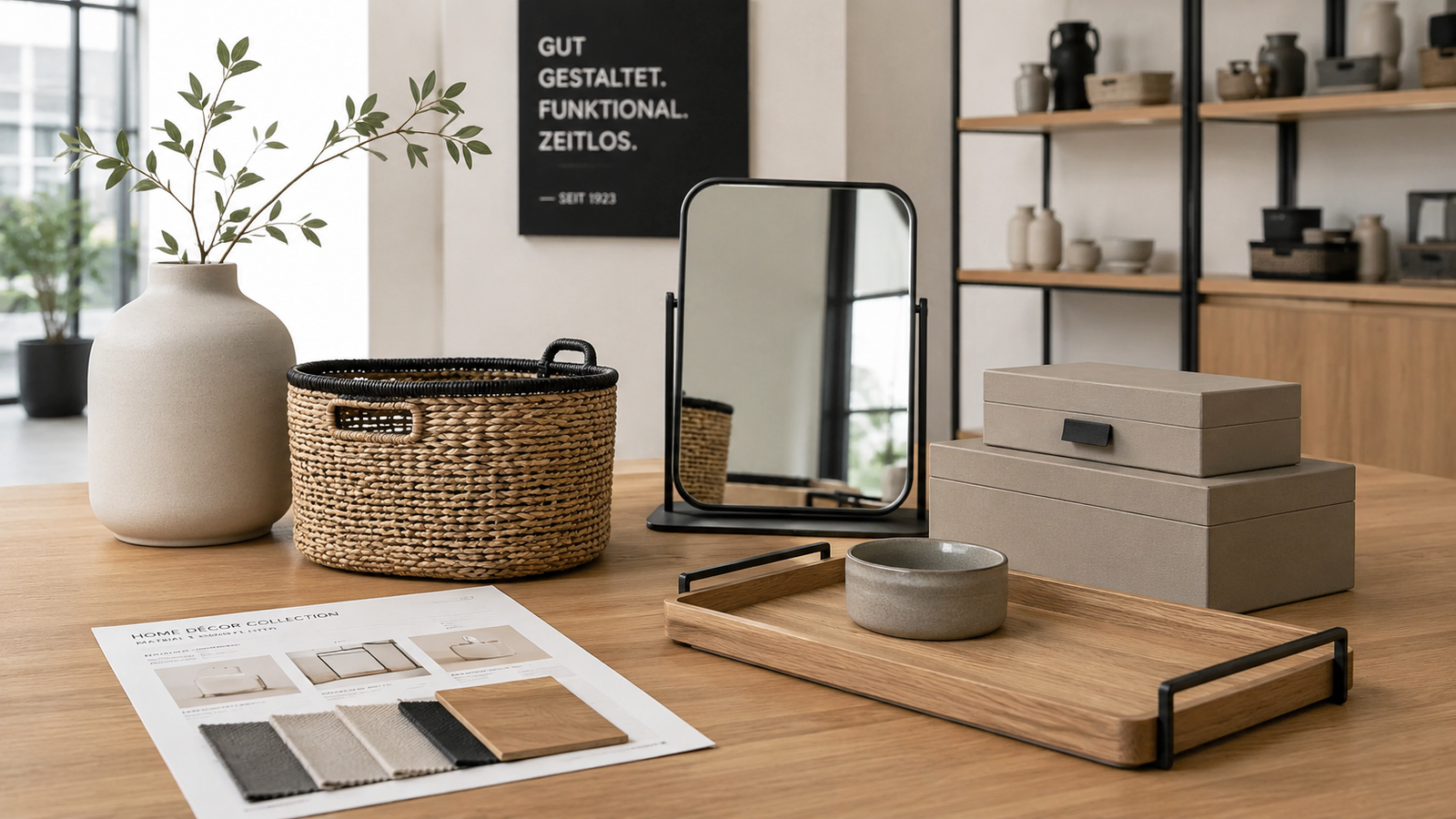
The Buyer Story: Good Products, but No Clear Collection
A German home décor buyer was preparing a new assortment for a group of regional home stores.
The supplier presented many attractive products:
Ceramic vases.
Decorative trays.
Storage boxes.
Mirrors.
Baskets.
Small upholstered benches.
Candle holders.
Textile accessories.
The buyer liked several individual items. However, when the products were placed together, the collection did not look complete.
The ceramic tones were too warm for the textiles.
The wood finishes did not match.
The storage products looked functional, but not decorative.
Some products were suitable for shelves, while others required more floor space than the stores could provide.
The problem was not product quality.
The problem was category planning.
A professional home décor category guide helps buyers move from individual product selection to a coherent commercial assortment. It connects materials, finishes, shelf space, packaging, private-label development and supplier operations into one buying system.
Why German Buyers Need Category-Level Sourcing
Home décor categories are highly connected.
A vase is rarely displayed alone.
A tray may be styled with candles, decorative objects or bathroom accessories.
A basket may be sold as storage, but its material and colour must still fit the surrounding furniture.
For German buyers, the category therefore needs to be evaluated at three levels:
The individual product.
The product family.
The complete retail presentation.
A product can be attractive on its own and still fail within the wider assortment.
Category-level sourcing asks:
Does the item fit the target customer?
Does it work with other materials and finishes?
Can it be displayed clearly?
Does its packaging suit the retail channel?
Can the supplier reproduce the collection over several seasons?
German Trade Fair Signals: Material Character and Commercial Clarity
German trade fairs continue to show that buyers are looking for products with a clear material story and realistic retail application.
Heimtextil Trends 26/27 highlights visible craftsmanship, including irregular dyeing, knots, seams and asymmetrical finishes. These details are presented as intentional expressions of material character rather than manufacturing defects.
This direction is relevant beyond textiles. It supports ceramic surfaces, woven storage, natural wood, tactile upholstery and other products where controlled variation adds perceived value.
The German furniture market is also under pressure from changing consumer behaviour, fragmented demand and price sensitivity. This makes focused, understandable assortments more important than oversized collections with too many weak SKUs.
For buyers, the practical message is clear:
The collection should feel distinctive, but it must also remain easy to compare, display, replenish and explain.
Home Decor Materials and Finishes: The Basis of a Cohesive Collection
Home decor materials and finishes should be selected before the final SKU list is completed.
Buyers often begin with product types, but a more effective process starts with a material and finish framework.
For example, a collection may be based on:
Warm oak.
Matte ivory ceramic.
Natural woven fibres.
Soft beige upholstery.
Dark bronze metal.
Smoked glass.
This framework creates visual consistency across different categories.
Typical Material Families
| Material Family | Product Applications | Buyer Consideration |
|---|---|---|
| Ceramic | Vases, trays, candle holders, jars | Glaze variation and chip risk |
| Wood | Mirrors, trays, boxes, small furniture | Finish consistency and moisture control |
| Metal | Frames, candle holders, decorative objects | Coating, corrosion and scratch resistance |
| Woven fibre | Baskets, storage, planters | Shape variation, odour and recovery |
| Textile | Ottomans, cushions, storage benches | Abrasion, colour and batch consistency |
| Glass and mirror | Trays, mirrors, decorative objects | Thickness, tint, edge quality and packaging |
The goal is not to use only one material.
The goal is to create cohesive home decor materials and finishes that can be displayed together.
Wholesale Home Decor Materials Must Be Commercially Repeatable
Wholesale home decor materials need a different evaluation from one-off designer products.
A handcrafted finish may look excellent in one sample, but the supplier must still control acceptable variation across a complete order.
German buyers should define:
Colour tolerance.
Surface tolerance.
Material thickness.
Finish reference.
Acceptable natural variation.
Repeat-order expectation.
This is especially important for ceramic glaze, natural stone, woven fibres, wood grain and hand-applied finishes.
A supplier should not promise that every handcrafted piece will be identical.
It should explain which differences are intentional and which differences count as defects.
Private Label Home Decor Supplier: More Than a Logo
A private label home decor supplier should support more than packaging with the buyer’s brand name.
Private-label development may include:
Product selection.
Custom colours.
Exclusive finish combinations.
Packaging design.
Barcode and label application.
Product photography.
Specification sheets.
Care instructions.
Collection naming.
For German retailers, a private-label programme should create differentiation without adding unnecessary complexity.
Questions to Ask a Private-Label Supplier
Can the supplier maintain the same finish over repeat orders?
Can several product types use one coordinated colour story?
What changes require a new mould?
Which changes affect MOQ?
Can packaging be adapted for stores and e-commerce?
Can the supplier provide EU-ready product information?
Can damaged parts or replacement units be ordered later?
The supplier’s development process is often more important than the number of customisation options offered.
Export Operations Team Home Decor: The Team Behind the Product
The export operations team home decor buyers work with can strongly influence delivery performance.
A good product may still create problems if the export team does not control documents, carton data, labelling and shipment timing.
A professional export operations team should coordinate:
Purchase-order confirmation.
Sample approval.
Production schedule.
Quality inspection.
Carton markings.
Commercial documents.
Container loading.
Shipment updates.
Claims and replacement handling.
For buyers, this team is not an administrative detail.
It is part of supplier capability.
Signs of a Strong Export Operations Team
The team confirms specifications in writing.
It uses consistent SKU references.
It identifies delays before the shipping date.
It provides correct carton dimensions and weights.
It records approved packaging.
It can trace production and inspection status.
It responds clearly when problems occur.
An organised export team reduces hidden work for the buyer.
Decorative Storage for Living Rooms: Function Must Support the Interior
Decorative storage for living rooms is a strong category because it combines organisation with visible home décor.
Typical products include:
Lidded baskets.
Storage ottomans.
Decorative boxes.
Console baskets.
Magazine storage.
Trays with storage functions.
Small benches with hidden compartments.
The product must solve a practical problem, but it should not look like utility-room storage.
What German Buyers Should Evaluate
Does the product fit modern living rooms?
Can it remain visible when not in use?
Does it coordinate with furniture and textiles?
Is the storage volume meaningful?
Can customers understand the function immediately?
Does the packaging preserve the product’s shape?
For community and regional home stores, decorative storage can be especially useful because it provides an easy product story: organisation without losing atmosphere.
Home Decor Shelf Logic: Every SKU Needs a Position
Home decor shelf logic means planning how products work together on the actual retail fixture.
A catalogue collection may contain 50 products, but a shelf may only have space for 12.
Buyers therefore need to decide:
Which product creates visual focus?
Which items provide price entry?
Which products add height?
Which products create texture?
Which items can be grouped as sets?
Which colours should repeat across the display?
A Simple Shelf Structure
| Shelf Role | Example Product | Commercial Function |
|---|---|---|
| Visual anchor | Large vase or mirror | Attracts attention |
| Mid-size core | Tray, storage box or basket | Generates regular sales |
| Small add-on | Candle holder or decorative object | Supports impulse purchase |
| Texture item | Woven basket or textile storage | Adds material contrast |
| Premium item | Inlaid box or sculptural object | Raises perceived value |
A good shelf should not contain only similar-sized objects.
It should create rhythm through height, scale, finish and function.
Home Decor for Community Home Stores
Home decor for community home stores requires a different assortment from large national chains or luxury design showrooms.
Community stores often serve local customers who value:
Practical use.
Accessible prices.
Easy product understanding.
Reliable quality.
Flexible quantities.
Regular assortment updates.
For these stores, the best products are often not the most experimental.
They are products with enough design character to feel new, but enough familiarity to sell without long explanation.
Suitable Categories
Decorative storage.
Ceramic vases.
Small mirrors.
Baskets.
Trays.
Candle holders.
Compact benches.
Seasonal accent products.
The assortment should also allow smaller opening quantities and manageable replenishment.
How to Build a Cohesive Home Décor Collection
A cohesive collection can be built in five steps.
Step 1: Define the Customer
Is the collection for a price-conscious family customer, a design-led urban customer or a premium homeowner?
Step 2: Set the Material Palette
Choose three to five core materials or finishes that can repeat across categories.
Step 3: Assign Product Roles
Each SKU should function as a hero item, core item, price-entry product, add-on item or seasonal update.
Step 4: Test Shelf Compatibility
Check whether the products work together in scale, colour and visual density.
Step 5: Review Packaging and Replenishment
Confirm carton size, breakage risk, storage requirements and reorder quantity before final approval.
Example: Living-Room Decorative Storage Collection
A German buyer may build one collection around warm neutral living-room storage.
Hero Product
A reeded wood storage bench with upholstered seat.
Core Products
Two woven baskets in different sizes.
A matte ceramic lidded jar.
A decorative tray in dark bronze.
Add-On Products
Small storage boxes.
Candle holders.
A matching tabletop mirror.
Material Story
Natural oak.
Warm beige textile.
Ivory ceramic.
Dark bronze metal.
Natural fibre.
This assortment feels coordinated without making every item identical.
Supplier Evaluation for a Category Programme
A supplier may be strong in one product but weak in complete category development.
German buyers should therefore evaluate whether the supplier can support:
Multiple coordinated materials.
Shared colour stories.
Consistent packaging language.
Private-label requirements.
Mixed-category shipments.
Small test orders.
Repeat production.
Product data and photography.
A supplier that only quotes individual SKUs may remain useful for commodity purchases.
A supplier that can organise products into commercial collections becomes a category partner.
What Should Be Included in a Category Pack?
A professional category pack should include:
| Section | Buyer Requirement |
|---|---|
| Product overview | Full SKU list and product roles |
| Material board | Core materials, colours and finishes |
| Specifications | Dimensions, materials and functions |
| Shelf proposal | Suggested display grouping |
| Packaging data | Carton size, weight and inner protection |
| Commercial terms | MOQ, price, lead time and reorder quantity |
| Private-label options | Logo, packaging, colours and exclusivity |
| Export plan | Production, inspection and delivery milestones |
This reduces repeated communication and helps the buyer prepare internal reviews.
Structured Buyer Summary
A home décor category guide is a sourcing framework used to build coordinated product collections across materials, finishes, product roles, shelf displays, packaging and delivery.
German buyers should evaluate home decor materials and finishes as a connected system rather than as isolated product details. A private label home decor supplier should support product development, coordinated finishes, packaging, labelling and repeat production. The supplier’s export operations team should manage specifications, inspection, documentation and shipping clearly.
Decorative storage for living rooms is commercially useful when it combines visible design value with practical organisation. Home decor shelf logic determines how hero products, core products, add-ons and premium items work together in stores. For community home stores, assortments should remain clear, accessible and easy to replenish.
Final Buyer Takeaway
A strong home décor category is not created by selecting many attractive products.
It is created by making deliberate connections.
The materials must relate.
The finishes must repeat.
The products must have clear roles.
The packaging must support the channel.
The export team must support the order.
For German buyers, the best supplier is not only a manufacturer of individual products.
It is a partner that can help turn wholesale home décor materials into a cohesive, private-label, retail-ready collection.
FAQ
What is a home décor category guide?
A home décor category guide is a B2B sourcing framework that explains how buyers should select, coordinate and evaluate products within a home décor category.
What should buyers expect from a private label home decor supplier?
Buyers should expect support with product development, custom finishes, packaging, labels, specifications, product images and repeat-order consistency.
Why are cohesive home decor materials and finishes important?
They help different product types work together visually, making the collection easier to display, explain and sell.
What is home decor shelf logic?
Home decor shelf logic is the method of arranging products by role, size, height, material, price and visual impact on a retail fixture.
What makes decorative storage suitable for living rooms?
Decorative storage should provide practical capacity while remaining attractive enough to stay visible in the room.
What should an export operations team provide?
The export operations team should coordinate order confirmation, sample approval, production, inspection, packaging, documentation, loading and shipment updates.



