
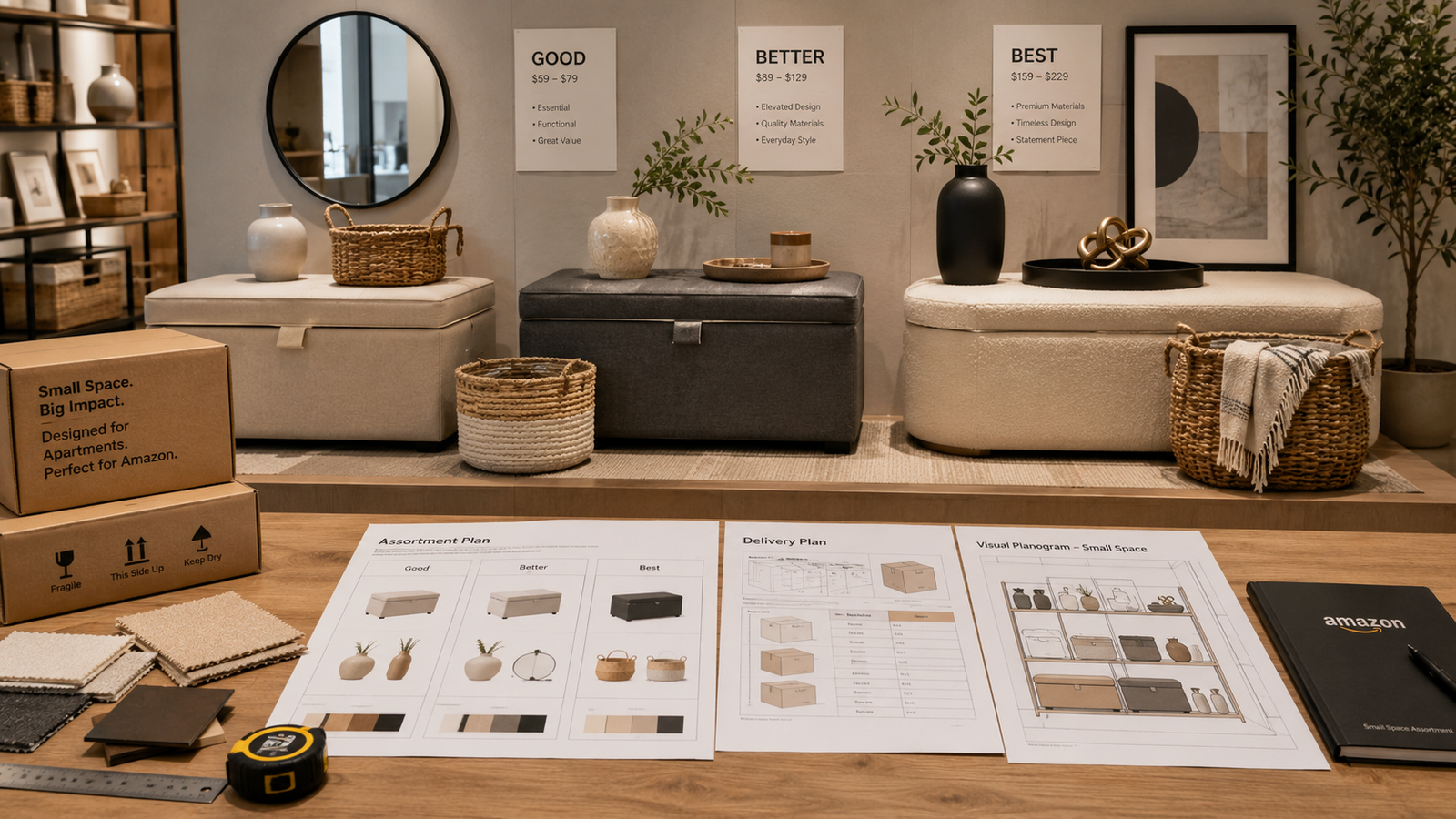
The Buyer Story: The Products Were Good, But the Assortment Was Not
A U.S. home décor buyer once sourced a group of strong products from different suppliers.
There was a textured storage ottoman that looked great in photos.
There was a mirror with a strong frame finish.
There were ceramic vases, trays, baskets, and a few small accent tables.
Individually, each item made sense.
But when the retailer tried to launch the collection, the problem became clear.
The colors did not connect.
The price points were too close.
The packaging sizes created delivery issues.
The store team did not know how to display the products together.
The Amazon team could not decide which SKUs should become hero listings.
Nothing was truly wrong with the products.
The assortment strategy was wrong.
That is why retail assortment planning matters. For U.S. home décor buyers, the job is not only choosing attractive items. The job is building a coordinated product system that works in stores, online, in warehouses, and in the customer’s home.
Why Retail Assortment Planning Is More Important in Home Décor
Home décor is not bought like a single replacement part.
Customers often buy through mood, room setting, lifestyle, color story, and perceived value.
A vase sells better when it belongs to a tabletop story.
A mirror sells better when it anchors an entryway display.
A storage bench sells better when it is shown with baskets, rugs, hooks, and wall décor.
This is why a retail-ready home decor assortment should not be built as a random SKU list. It should be planned around rooms, customer needs, price ladders, display logic, and delivery reality.
For buyers, the best question is not:
“What products can we buy?”
The better question is:
“What product roles do we need in the assortment?”
U.S. Trade Show Signals: Buyers Are Looking for Stories, Not Just SKUs
At High Point Market, the Style Spotters program focuses on product and trend discovery through multiple design perspectives, showing how important curated interpretation has become for the home furnishings industry.
Las Vegas Market positions itself as a major West Coast marketplace where buyers source furniture, home décor, and gift products across more than 3,500 brands, which reflects the need for cross-category buying and coordinated retail discovery.
Atlanta Market is also structured around broad wholesale sourcing across home furnishings, gift, design, and related categories, with access for retailers, buyers, designers, specifiers, and purchasing companies.
For home décor buyers, these market signals point to one practical lesson: the winning assortment is not only trend-correct. It must be easy to understand, easy to display, easy to replenish, and easy to sell across channels.
Assortment Strategy Starts with Product Roles
A strong assortment strategy begins by assigning roles before selecting products.
Every SKU should have a purpose.
Some products attract attention.
Some products create margin.
Some products complete a room story.
Some products support online search demand.
Some products make the price ladder feel accessible.
Common Product Roles in Home Décor Assortments
| Product Role | Example | Buyer Purpose |
|---|---|---|
| Hero SKU | Oversized mirror, boucle chair, statement vase | Creates visual impact |
| Traffic SKU | Small tray, candle holder, ceramic accent | Easy entry price |
| Margin SKU | Decorative set, premium finish, larger item | Improves profitability |
| Companion SKU | Basket, rug, ottoman, wall hook | Completes the room story |
| Online SKU | Search-friendly storage bench or mirror | Captures marketplace demand |
| Seasonal SKU | Holiday décor, harvest ceramic, summer tabletop | Refreshes the assortment |
When buyers understand the role of each SKU, they avoid overbuying similar products.
Good Better Best Assortment: Building a Clear Price Ladder
A good better best assortment is one of the most useful planning tools for home décor buyers.
It gives customers clear choices.
It also helps retailers serve different budgets without confusing the category.
Example: Storage Ottoman Program
| Tier | Product Direction | Buyer Logic |
|---|---|---|
| Good | Basic fabric storage ottoman | Entry price, broad appeal |
| Better | Tufted or boucle storage ottoman | Better texture, stronger visual value |
| Best | Premium shearling-style or wood-base ottoman | Higher margin, showroom impact |
Example: Mirror Program
| Tier | Product Direction | Buyer Logic |
|---|---|---|
| Good | Simple framed wall mirror | Everyday retail |
| Better | Brass or reeded wood frame mirror | Style upgrade |
| Best | Oversized, inlaid, travertine, or backlit mirror | Statement and premium positioning |
The key is not simply making three price points.
The buyer must make the value difference visible.
Customers should immediately understand why one item costs more than another.
Small Space Assortment Planning: Design for Apartments, Entryways and Flexible Rooms
Small space assortment planning is increasingly important for U.S. home buyers because many consumers need furniture and décor that work in apartments, condos, townhomes, and multifunctional rooms.
Small space does not mean low value.
It means every product must justify its footprint.
Good small-space products often combine:
Storage.
Seating.
Decorative value.
Easy delivery.
Flexible placement.
Strong Small-Space Product Directions
Storage ottomans.
Nesting tables.
Slim entryway benches.
Wall mirrors.
Compact accent chairs.
Stackable baskets.
Multi-use trays.
Floating shelves.
For buyers, the key is to build small-space assortments around use cases, not just dimensions.
An entryway set might include a shoe storage bench, wall mirror, hooks, rug, and baskets.
A small living room set might include a compact ottoman, side table, floor lamp, tray, and decorative cushions.
Amazon Assortment Strategy: Think Search, Photos and Returns
An amazon assortment strategy is different from a store assortment strategy.
In stores, the customer sees a display.
On Amazon, the customer sees a title, image, price, reviews, and delivery promise.
For marketplace channels, buyers should plan SKUs around search intent and operational risk.
A product may look beautiful but fail online if it is hard to explain, hard to photograph, or expensive to return.
Amazon-Friendly Home Décor Assortment Rules
Choose products with clear search demand.
Use simple, understandable product names.
Keep dimensions easy to understand.
Avoid fragile items unless packaging is strong.
Create color or size variations carefully.
Make sure the hero image communicates the use case.
Do not launch too many similar SKUs at once.
For Amazon, the best assortment is often tighter than a store assortment.
A focused product family with clear variation can outperform a broad but confusing SKU list.
Planogram-Ready Assortment: Make the Store Team’s Job Easier
A planogram-ready assortment is designed so the retailer can display it without guessing.
This is especially important for multi-store chains, regional retailers, and wholesale buyers serving independent stores.
A product assortment may be beautiful in a supplier showroom but fail in store because it does not fit shelves, fixtures, tables, or wall displays.
What Makes an Assortment Planogram-Ready?
The assortment has a clear color story.
Products are grouped by room or use case.
Sizes work together.
Packaging does not block shelf visibility.
Hero items are supported by smaller add-ons.
Price points are easy to read.
The display can be repeated across stores.
For home décor suppliers, offering a planogram-ready assortment creates more value than simply providing product photos.
It helps buyers imagine how the collection will sell.
Delivery Planning: The Hidden Part of Assortment Strategy
Delivery planning is often treated as a logistics issue, but it should be part of assortment strategy from the beginning.
A beautiful assortment can become unprofitable if carton sizes, breakage rates, freight class, or warehouse handling are ignored.
This is especially true for:
Oversized mirrors.
Ceramic décor.
Small furniture.
Storage benches.
Lighting.
Fragile tabletop products.
Delivery Planning Questions for Buyers
Can the products ship together efficiently?
Are carton sizes compatible with the retailer’s warehouse?
Are fragile items protected for parcel shipping?
Do large items require special handling?
Can replenishment arrive before peak season?
Are SKUs grouped by launch timing?
Can the supplier support phased delivery?
Delivery planning connects buying decisions to cash flow, warehouse capacity, launch dates, and customer satisfaction.
Retail-Ready Home Decor Assortment: What Suppliers Should Provide
A retail-ready home decor assortment should come with more than product samples.
For U.S. buyers, suppliers should provide information that supports purchasing, merchandising, logistics, marketing, and customer service.
A Retail-Ready Assortment Pack Should Include
| Area | What Buyers Need |
|---|---|
| Product data | SKU, dimensions, materials, colors, MOQ |
| Visual assets | Product photos, lifestyle photos, detail shots |
| Packaging data | Carton size, weight, inner protection |
| Display logic | Room story, color story, planogram suggestion |
| Price ladder | Good, better, best structure |
| Channel notes | Store, Amazon, wholesale, designer channel |
| Delivery plan | Lead time, phased shipment, replenishment options |
A supplier that can provide this level of support becomes more than a vendor.
It becomes a category partner.
How Buyers Build a Better Assortment from the Same Products
The buyer from the opening story changed the process.
Instead of buying individual products from different suppliers, the buyer rebuilt the collection around three rooms:
Entryway.
Small living room.
Bedroom storage.
Each room received a good-better-best price ladder.
Each group had one hero product, two companion products, and several easy add-on items.
The Amazon team received a tighter SKU list with clear titles and variation strategy.
The store team received display guidance.
The logistics team reviewed carton sizes before final purchase order approval.
The result was not simply a better product mix.
It was a better retail system.
Structured Buyer Summary
Retail assortment planning is the process of selecting and organizing products so they work together across customer needs, retail displays, price points, channels, and delivery requirements.
A strong home décor assortment strategy should define product roles, good-better-best price levels, small-space solutions, Amazon listing logic, planogram-ready display structure, and delivery planning before orders are placed. A retail-ready home décor assortment should include product data, visual assets, packaging information, display suggestions, price ladder, channel notes, and replenishment planning.
For U.S. home buyers, successful assortment planning turns individual products into a sellable category program.
Final Buyer Takeaway
A strong home décor assortment does not happen by accident.
It is planned.
The best buyers do not only ask suppliers for product lists.
They ask for product roles, price ladders, packaging details, display logic, and channel strategy.
The best suppliers do not only sell items.
They help buyers build collections that work in stores, online, in warehouses, and in real homes.
That is the difference between a product order and a retail-ready assortment.
FAQ
What is retail assortment planning?
Retail assortment planning is the process of selecting, grouping, pricing, and organizing products so they meet customer demand, fit retail channels, and support profitable sales.
What is a good better best assortment?
A good better best assortment offers products at three value levels: entry-level, upgraded, and premium. It helps customers compare options and helps retailers build a clear price ladder.
Why is small space assortment planning important?
Small space assortment planning helps retailers serve customers in apartments, condos, entryways, and multifunctional rooms where products must provide strong function without taking up too much space.
How is Amazon assortment strategy different from store assortment strategy?
Amazon assortment strategy focuses more on search demand, product titles, images, reviews, packaging, and return risk. Store assortment strategy focuses more on display impact and in-person merchandising.
What does planogram-ready assortment mean?
A planogram-ready assortment is designed to be displayed easily in retail stores, with clear product grouping, color coordination, size planning, and repeatable fixture logic.
Why should delivery planning be part of assortment strategy?
Delivery planning affects cost, launch timing, warehouse handling, breakage risk, and customer experience. It should be considered before finalizing the product assortment.