
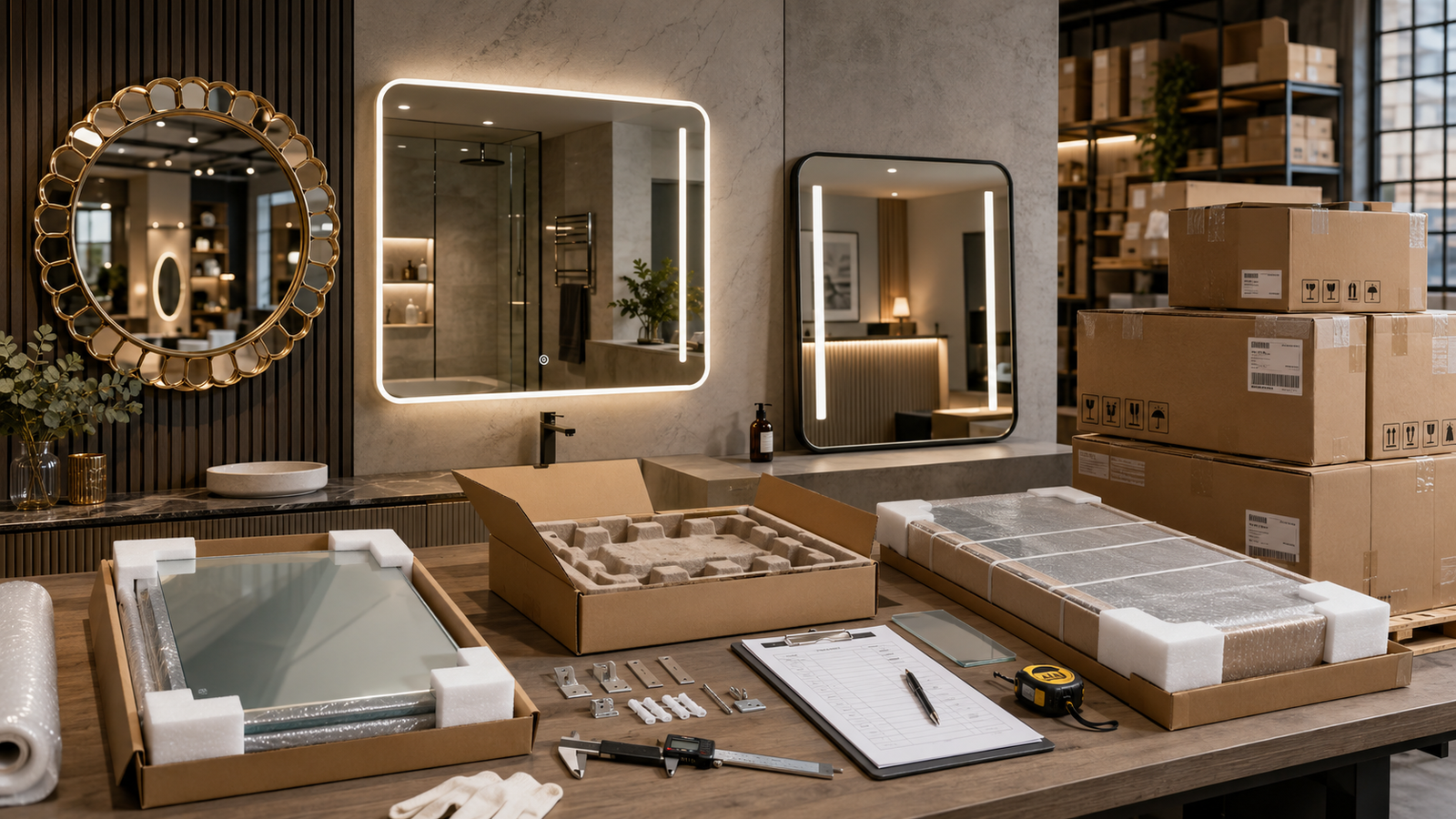
The Buyer Story: A Mirror Order That Looked Easy Until It Shipped
A U.S. home décor buyer found a promising mirror supplier after reviewing samples for a bathroom and entryway mirror program. The designs looked strong: one rounded rectangle mirror for retail stores, one LED bathroom mirror for hospitality projects, and one decorative wall mirror for online sales.
The quotation looked competitive. The lead time was acceptable. The supplier said the packaging was “safe for shipping.”
Then the buyer asked three questions:
What is the exact LED mirror IP rating?
Can you show the real mirror packaging for shipping?
Can you explain your mirror manufacturing process from glass cutting to final carton?
That was when the sourcing conversation changed. The supplier could make mirrors, but the buyer needed more than mirrors. The buyer needed a product that could survive shipping, pass project expectations, match listing specifications, and reduce return risk.
For U.S. home décor buyers, that is the real difference between buying a mirror and building a mirror supply program.
Why Mirrors Remain Important in U.S. Home and Hospitality Channels
Mirrors continue to be a strong category because they sit across multiple buying channels: home décor, bathroom renovation, hospitality, furniture retail, e-commerce, builder supply, and interior design projects.
Recent U.S. market signals support this direction. High Point Market continues to use Style Spotters to identify new products and design inspiration across the home furnishings industry, showing how decorative products with strong visual identity remain important for buyers. Las Vegas Market positions itself as a major West Coast marketplace for furniture, home décor, and gift products, with more than 3,500 brands across permanent and temporary collections.
For mirror buyers, the implication is clear: mirrors are no longer only functional wall items. They are design statements, bathroom upgrade products, lighting products, hospitality specifications, and online décor SKUs.
Speculum Mirror vs. Decorative Mirror: Why Search Intent Matters
The keyword speculum mirror can create confusion. In technical or medical contexts, “speculum” may refer to an instrument or reflective metal surface. In home décor sourcing, many buyers are usually looking for a high-clarity mirror, specular reflection quality, polished reflective glass, or specialty mirror finish.
For a U.S. home décor buyer, this matters because unclear terminology can lead to wrong supplier matches. A decorative mirror supplier may not serve medical or optical applications. A glass processor may not understand retail packaging. A bathroom mirror supplier may understand LED and anti-fog features but not decorative frame trends.
Buyer Takeaway
When using terms such as speculum mirror or specialty mirror in supplier communication, buyers should clarify whether they mean decorative mirror glass quality, optical reflection performance, metal reflective finish, or a specific technical application.
Mirror Manufacturing Process: What Buyers Should Understand Before Ordering
A good buyer does not need to become a factory engineer, but understanding the mirror manufacturing process helps prevent avoidable problems.
A typical decorative or bathroom mirror process includes glass selection, cutting, edging, washing, coating or silvering, backing protection, frame production, assembly, hardware installation, inspection, cleaning, packaging, and carton loading.
For LED mirrors, the process adds electrical components, LED strips, power supply, wiring, touch controls, anti-fog pads, waterproof design, and electrical testing.
Key Production Stages Buyers Should Ask About
| Stage | Buyer Question | Risk If Ignored |
|---|---|---|
| Glass selection | What glass thickness and grade are used? | Distortion, weak structure, poor reflection |
| Cutting and edging | Are edges polished, beveled, or covered by frame? | Chipping, safety issues, poor finish |
| Backing | What backing paint or board protects the mirror? | Corrosion, black spots, moisture damage |
| Frame production | What material and finish are used? | Color variation, warping, weak joints |
| Hardware | What hanger, screws, or brackets are included? | Installation complaints, safety risk |
| LED assembly | What LED, driver, switch, and wiring are used? | Failure, flicker, electrical complaints |
| Inspection | What QC checks happen before packing? | Defects hidden until arrival |
| Packaging | What inner protection and carton structure are used? | Breakage and returns |
For U.S. buyers, the supplier’s answer should be specific. “Good quality” is not enough. The buyer needs dimensions, material descriptions, photos, test references, and packaging details.
LED Mirror IP Rating: What U.S. Buyers Should Check
The LED mirror IP rating is especially important for bathroom mirrors and hospitality projects. IP rating refers to ingress protection, which describes how an electrical enclosure is protected against dust, solid objects, and moisture. IEC 60529 is the international standard used to classify protection provided by enclosures for electrical equipment.
For bathroom mirrors, buyers should not assume every LED mirror is suitable for wet or humid spaces. Bathroom zones, installation location, local electrical rules, and project requirements can affect what rating is appropriate.
Practical IP Rating Questions for LED Mirror Buyers
What is the full IP rating of the LED mirror?
Is the rating for the whole unit or only a component?
Is the driver protected from bathroom moisture?
Are the LED strips sealed or exposed?
Is the anti-fog pad tested separately?
Can the supplier provide a test report or certification reference?
Does the product match U.S. project or retail channel requirements?
A higher IP rating may increase cost, but an unclear IP rating can create bigger risk. For hotel, multifamily, and bathroom retail programs, buyers should request documentation before placing bulk orders.
Mirror Packaging for Shipping: The Hidden Profit Protector
For U.S. buyers, mirror packaging for shipping is one of the most important parts of the order. A beautiful mirror that breaks in transit is not a product; it is a claim, a replacement cost, a negative review, and a margin problem.
Mirrors face several shipping risks: glass breakage, frame dents, corner impact, pressure cracks, hanger damage, carton compression, and parcel handling shock.
E-commerce and marketplace shipments make this harder. ISTA packaging test frameworks are designed to evaluate how packaging handles real transport hazards such as shock, vibration, compression, and handling stress. Amazon-related ISTA packaging procedures also focus on whether a product can survive fulfillment and delivery conditions.
Mirror Packaging Checklist for Buyers
| Packaging Area | What to Check |
|---|---|
| Corner protection | Foam, molded pulp, or reinforced corner guards |
| Glass protection | Surface film, foam sheet, spacer, or anti-scratch layer |
| Frame protection | Edge guards, soft wrap, and pressure control |
| Carton strength | Double-wall carton, compression resistance, correct flute |
| Inner movement | Mirror should not shift inside the carton |
| Hardware bag | Screws and hangers should not scratch the mirror |
| Labeling | Fragile marks, upright arrows, SKU, barcode, country of origin |
| E-commerce packaging | Parcel-ready design, drop-test reference, clean unboxing |
For large mirrors, buyers should also ask about palletization, vertical loading, container bracing, and warehouse handling instructions.
Dubai Mirror Supplier Searches: What U.S. Buyers Can Learn
The keyword Dubai mirror supplier often reflects international project sourcing. Dubai has strong demand for hotels, luxury residential interiors, retail spaces, and commercial fit-outs. U.S. buyers searching this term may be benchmarking project-style mirrors, hospitality finishes, luxury bathroom designs, or Middle East supplier networks.
However, a U.S. buyer should not assume that a Dubai-focused supplier automatically fits U.S. retail needs.
A Dubai project supplier may be strong in custom sizes, large mirrors, decorative finishes, and commercial installation coordination. But U.S. buyers still need U.S.-ready packaging, inch-based dimensions, barcode labeling, retail cartons, e-commerce testing logic, and U.S. channel communication.
Buyer Takeaway
Dubai mirror supplier searches can be useful for design benchmarking and hospitality inspiration, but U.S. buyers should still evaluate packaging, certification, lead time, MOQ, and retail documentation separately.
Hotel Bathroom Mirror Supplier Saudi Arabia: Project Logic vs. Retail Logic
The keyword hotel bathroom mirror supplier Saudi Arabia points to another important sourcing context: hospitality and project procurement in the Gulf region.
Hotel bathroom mirrors are different from ordinary home décor mirrors. They may require LED lighting, anti-fog function, high moisture resistance, consistent color temperature, large-volume repeatability, wall mounting safety, and project documentation.
For U.S. buyers, this search intent is useful because hospitality mirrors often demand stricter consistency than small retail décor mirrors. If a supplier claims experience with Saudi Arabia hotel bathroom mirror projects, buyers should ask for details.
Questions to Ask a Hotel Bathroom Mirror Supplier
Can the supplier produce repeated sizes consistently?
Can the supplier provide LED color temperature options?
Can the mirror support anti-fog function?
What is the LED mirror IP rating?
What mounting system is used?
Can packaging protect mirrors for long-distance shipping?
Can the supplier support project drawings and batch labeling?
Can the supplier maintain finish consistency across multiple hotel rooms?
Project experience is valuable, but the buyer should verify whether that experience applies to their own channel.
Decorative Mirror vs. Bathroom LED Mirror: Different Risk Profiles
A decorative mirror and a bathroom LED mirror may look similar in a catalog, but the sourcing risks are different.
A decorative mirror is judged mainly by design, frame finish, glass clarity, hanging safety, and packaging. A bathroom LED mirror adds electrical safety, moisture protection, lighting performance, anti-fog reliability, and installation requirements.
Buyer Comparison
| Mirror Type | Main Buyer Concern | Key QC Focus |
|---|---|---|
| Decorative wall mirror | Style, finish, packaging | Frame, glass, hanger, carton |
| Entryway mirror | Size, visual impact, durability | Frame strength, reflection, wall hardware |
| Bathroom mirror | Moisture resistance, easy cleaning | Backing, edge quality, corrosion control |
| LED bathroom mirror | Electrical function and moisture protection | IP rating, wiring, driver, LED, anti-fog |
| Hotel bathroom mirror | Repeatability and project reliability | Batch consistency, documentation, packaging |
For U.S. buyers, the right supplier depends on product type. A decorative frame factory may not be the best LED bathroom mirror supplier. A hotel project mirror supplier may not be the best Amazon parcel-shipping partner.
What U.S. Buyers Should Put in the Purchase Order
A mirror purchase order should be more detailed than a basic product name and price. The PO is where buyers protect themselves from vague promises.
Recommended PO Details
Product name and SKU
Overall dimensions in inches
Mirror glass thickness
Frame material and finish
Backing material
Hanger or mounting hardware
LED mirror IP rating, if applicable
Color temperature, wattage, and switch type, if applicable
Approved sample reference
Packaging structure and carton dimensions
Barcode and labeling requirements
Inspection standard
Lead time and shipment terms
Responsibility for packaging failure or major defects
The more technical the mirror, the more specific the PO should be.
A Better Buyer-Supplier Conversation
The buyer in the story did not cancel the order. Instead, the buyer changed the sourcing process.
The supplier was asked to send packaging photos before production. The LED mirror IP rating was documented. The mirror manufacturing process was reviewed by stage. The buyer requested a carton drop reference for the e-commerce SKU and stronger corner protection for large mirrors.
The first bulk shipment was not perfect, but it was controlled. Breakage risk was lower, product data was clearer, and the supplier became easier to evaluate for repeat orders.
That is what good sourcing looks like. The goal is not to find a supplier who says yes to everything. The goal is to find a supplier who can explain the product, control the process, and improve before the shipment leaves the factory.
Structured Sourcing Summary
Mirror packaging for shipping is the protective carton and inner structure used to reduce breakage, scratches, frame damage, and transit claims. For U.S. buyers, mirror packaging should be reviewed before bulk production, especially for large mirrors, LED bathroom mirrors, and marketplace products.
LED mirror IP rating describes the level of protection against dust and moisture for the electrical enclosure or product. Buyers should confirm whether the rating applies to the whole mirror, the LED system, or only selected components. The mirror manufacturing process usually includes glass selection, cutting, edging, washing, reflective coating, backing, frame production, assembly, inspection, and packaging. LED mirrors add lighting, wiring, driver, anti-fog, switch, and electrical testing steps.
Dubai mirror supplier and hotel bathroom mirror supplier Saudi Arabia searches can help buyers understand international project and hospitality demand, but U.S. buyers still need U.S.-specific packaging, dimensions, labeling, certification expectations, and retail channel support.
Final Buyer Takeaway
For U.S. home décor buyers, mirrors are attractive because they combine design value, functional use, and strong merchandising potential. But mirrors also carry real sourcing risk because glass, frames, LED components, and packaging must work together.
The best mirror supplier is not only the one with the best catalog image. It is the supplier who can explain the manufacturing process, document LED mirror IP rating, design reliable mirror packaging for shipping, and support the buyer’s channel—whether that channel is furniture retail, hospitality project supply, Amazon, regional wholesale, or interior design procurement.
FAQ
What is the most important factor in mirror packaging for shipping?
The most important factor is preventing movement and impact inside the carton. Buyers should check corner protection, glass surface protection, frame protection, carton strength, and whether the packaging fits parcel or pallet shipping.
What does LED mirror IP rating mean?
LED mirror IP rating refers to ingress protection against solids and moisture. For bathroom and hotel use, buyers should confirm the exact rating, what part of the product it applies to, and whether documentation is available.
What should buyers know about the mirror manufacturing process?
Buyers should understand glass thickness, cutting, edging, reflective coating, backing, frame assembly, hardware installation, LED assembly if applicable, inspection, and packaging. This helps buyers identify where quality problems may occur.
Is a Dubai mirror supplier suitable for U.S. buyers?
A Dubai mirror supplier may be useful for project-style or luxury mirror references, but U.S. buyers should still verify packaging, labeling, certifications, dimensions, MOQ, lead time, and channel-specific requirements.
What should hotel bathroom mirror buyers check?
Hotel bathroom mirror buyers should check size consistency, LED performance, anti-fog function, IP rating, mounting system, moisture resistance, batch labeling, packaging, and project documentation.



