
A project product must do more than look good in a sample photo
A hotel room, serviced apartment or interior fit-out project does not need products that are merely “nice”.
Nice is easy.
Nice is everywhere.
Nice is what suppliers say when they have run out of useful information.
For German buyers, project sourcing and delivery is about whether the product can be specified, produced, packed, shipped, installed and reordered without turning the project manager into a tired philosopher.
A dark wood bench, a bed end bench, an LED bathroom mirror, a round storage ottoman or an upholstered storage bench may look simple. But in a project, simple products still need structure, carton data, finish control, installation logic and clear communication.
Because when the product arrives late, damaged or in the wrong finish, nobody says, “At least the mood board was lovely.”
What is project sourcing and delivery?
Project sourcing and delivery means managing the full buying path for a defined project: product selection, specification, sample approval, production, packaging, shipment, delivery timing and replacement planning.
It usually includes:
- mirrors
- LED bathroom mirrors
- bed end benches
- dark wood benches
- round storage ottomans
- upholstered storage benches
- small furniture
- decorative ceramics
- wall décor
- phased delivery
- project documentation
In plain buyer language:
It is how you make sure products arrive correctly, not just attractively.
A project supplier should help buyers answer: What is the size? What is the finish? What is the packaging? What is the MOQ? What is the lead time? What can be customised? What should definitely not be touched unless everyone enjoys delays?
Dark wood bench: warm, useful, but finish-sensitive
A dark wood bench can work beautifully in hotel rooms, entrance areas, bedrooms, dressing zones and boutique retail spaces.
It brings weight, warmth and structure. It also pairs well with brass mirrors, smoked glass, neutral ottomans and ceramic décor.
But dark wood needs control.
German buyers should check:
- wood tone
- surface finish
- scratch resistance
- leg stability
- frame strength
- carton protection
- batch consistency
- whether the wood tone matches other room materials
A dark wood bench should look calm and expensive.
It should not look like a cheap bench wearing dark make-up.
Bed end bench: one of the most useful project furniture pieces
A bed end bench is practical because it gives the room function without taking over the space.
It can be used for:
- luggage placement
- soft seating
- bedroom styling
- dressing support
- hotel room function
- serviced apartment layouts
For project sourcing, buyers should check:
| Detail | Why It Matters |
|---|---|
| Bench height | must work with bed height |
| Seat depth | affects comfort and room flow |
| Frame strength | supports real use, not just photos |
| Upholstery | visible and touchable |
| Leg finish | must match mirrors, lighting or handles |
| Carton size | affects delivery and storage |
| Gross weight | matters for handling |
| Packaging | prevents dents, scratches and fabric marks |
A bed end bench is not just “something at the foot of the bed”.
It is the product guests actually use when they do not want to throw a suitcase onto clean bedding like a criminal.
Round storage ottoman: small product, big project value
A round storage ottoman is useful in projects because it solves several problems at once.
It can be:
- a seat
- a footrest
- a soft accent
- a hidden storage piece
- a compact room solution
- a companion to mirrors and benches
For German buyers, this makes it a good project product — if it is controlled properly.
Check:
- lid fit
- storage depth
- fabric texture
- foam support
- stitching
- base stability
- carton compression
- fabric batch repeatability
A round storage ottoman should feel useful, not gimmicky.
If the lid wobbles, the fabric wrinkles and the storage space is too small, it is not multifunctional.
It is just confused.
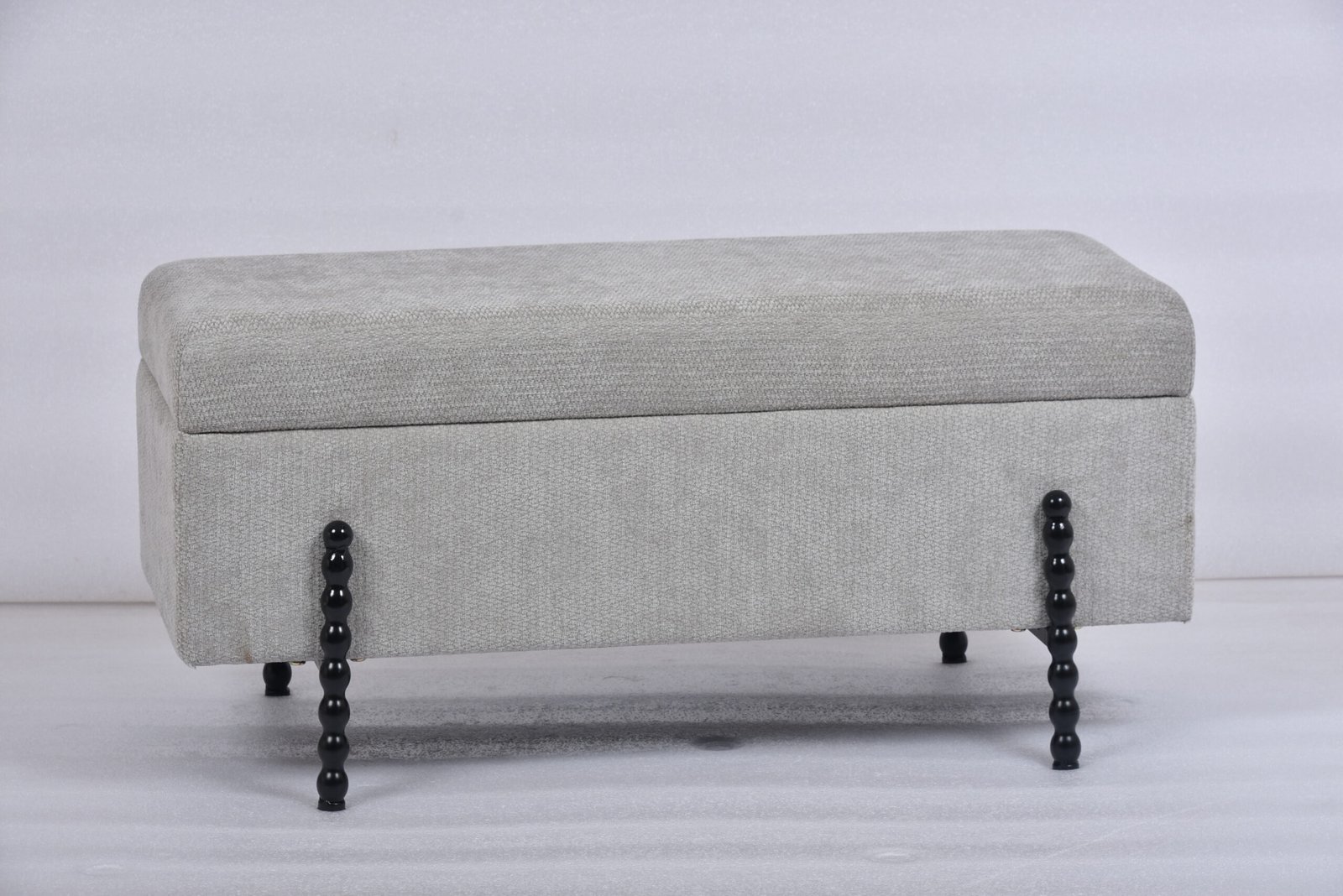
Upholstered storage bench: function with a fabric problem attached
An upholstered storage bench can be excellent for bedrooms, hallways, hotel rooms and serviced apartments.
It gives seating plus storage, which sounds simple enough until the details begin misbehaving.
Buyers should check:
- fabric handfeel
- fabric colour under different lighting
- hinge quality
- lid opening angle
- foam density
- frame strength
- inner storage finishing
- upholstery tension
- carton protection
- reorder fabric availability
This is where project buyers must be strict.
A storage bench that looks good but opens badly will annoy customers every day.
Daily annoyance is not a design feature.
LED mirror IP rating: not a decorative detail
An LED mirror is not just a mirror with a bit of light.
For project buyers, LED mirror IP rating must be checked before the order is confirmed, especially when mirrors are intended for bathroom or wet-area use.
Buyers should ask:
- What is the LED mirror IP rating?
- Is the rating documented?
- Which components are covered?
- Is the mirror suitable for the intended room?
- What is the voltage?
- What is the wattage?
- What is the CCT?
- Is there anti-fog function?
- Are installation notes available?
- Will the same components be used in reorder?
A bathroom mirror is not the place for vague optimism.
“Should be fine” is not a specification.
It is a sentence that often arrives before trouble.
Mirror packaging for shipping: where margin quietly disappears
Mirror packaging for shipping is part of the product, not an afterthought.
For project supply, buyers should confirm:
| Packaging Detail | What to Check |
|---|---|
| Carton size | affects logistics and site storage |
| Gross weight | affects handling |
| Inner protection | protects glass and frame |
| Corner guards | prevents common breakage |
| Hardware bag position | avoids loose parts damaging glass |
| Fragile marking | helps warehouse handling |
| Pallet plan | supports phased delivery |
| Replacement plan | protects project schedule |
A mirror with weak packaging is not cheaper.
It is just waiting to become broken in a more expensive location.
When should interior designers customize a product?
This is a key project question: when should interior designers customize a product?
They should customise when:
- the standard size does not fit the room
- the finish does not match the project palette
- the product will be used across several rooms
- the change improves function
- the supplier can document the change clearly
- MOQ and lead time still make sense
They should be careful when:
- custom size changes packaging
- custom finish is hard to repeat
- LED components must change
- the order quantity is small
- the change is based only on personal taste
- the project schedule is already tight
Customisation is useful when it solves a real problem.
It is dangerous when it becomes a hobby.
Comparison: custom size vs custom finish
| Decision | Custom Size | Custom Finish |
|---|---|---|
| Best for | room-specific fit, hotel layouts, built-in spaces | design coordination, material palette, visual upgrade |
| Risk | new carton, longer lead time, structure changes | colour variation, finish repeatability |
| Example | custom bed end bench length | dark wood finish, new upholstery, brass mirror frame |
| Easier to reorder? | usually harder | easier if finish is documented |
| Buyer advice | use only when the room demands it | use when the project needs visual alignment |
For many projects, custom finish is safer than custom size.
A new finish can make the product feel project-specific while keeping the structure, carton and production process stable.
That is how you customise without inviting chaos to the meeting.
Teruier’s cross-border design manufacturing model
For this article, Teruier’s cross-border design manufacturing model is the right framework.
Project products need design, manufacturing and delivery to work together.
Teruier’s model connects:
- Design intention
What does the project need: dark wood, soft upholstery, storage, LED mirror function, warm bedroom styling? - Product specification
What are the size, finish, fabric, IP rating, carton size and gross weight? - Manufacturing control
Can the supplier repeat the frame, fabric, finish and components? - Packaging and export delivery
Can mirrors, benches and ottomans arrive safely and in the right phase? - Project result
Can the buyer reduce delay, damage, wrong specs and replacement cost?
This is the difference between buying products and managing project supply.
One fills a container.
The other protects the project.
FAQ
What is project sourcing and delivery?
Project sourcing and delivery means managing product selection, specifications, sample approval, production, packaging, shipment, delivery timing and replacement planning for a defined project.
Why is a dark wood bench useful in projects?
A dark wood bench adds warmth, structure and function to hotel rooms, entryways, bedrooms and boutique interiors. Buyers should control wood tone, finish, strength and packaging.
What should buyers check in a bed end bench?
They should check height, depth, frame strength, upholstery quality, leg finish, carton size, gross weight and packaging.
Why is LED mirror IP rating important?
LED mirror IP rating helps confirm whether the mirror is suitable for its intended environment, especially bathrooms or wet-area projects. Buyers should request clear documentation.
Why does mirror packaging for shipping matter?
Mirrors are fragile. Poor packaging can cause breakage, delivery delays, replacement cost and project disruption.
Is a round storage ottoman useful for project supply?
Yes. It works as seating, storage and soft décor. Buyers should check lid fit, storage depth, fabric texture, stitching, foam support and carton compression.
What should buyers check in an upholstered storage bench?
They should check fabric quality, hinge performance, lid opening, inner storage finish, foam density, frame strength and packaging.
When should interior designers customize a product?
Interior designers should customise when the change solves a real project problem, improves fit or finish, and can be documented without damaging lead time or reorder stability.
Final thought: project products must behave after the sample stage
For German buyers, project sourcing and delivery rewards calm, clear, well-specified products.
A dark wood bench needs finish control.
A bed end bench needs proper structure.
An LED mirror needs a documented IP rating.
Mirror packaging must survive shipping.
A round storage ottoman must open and close properly.
An upholstered storage bench must look good and work daily.
Project buying is not about finding the most exciting sample.
It is about choosing products that arrive correctly, install smoothly and do not become everyone’s problem after approval.



