Product Introduction
For a mall buyer, storage is often a difficult category to merchandise well. Hard storage solves the function problem, but it can make the floor feel cold. Casual baskets can be easy to buy, but they often look too soft or too basic to support a stronger price story.
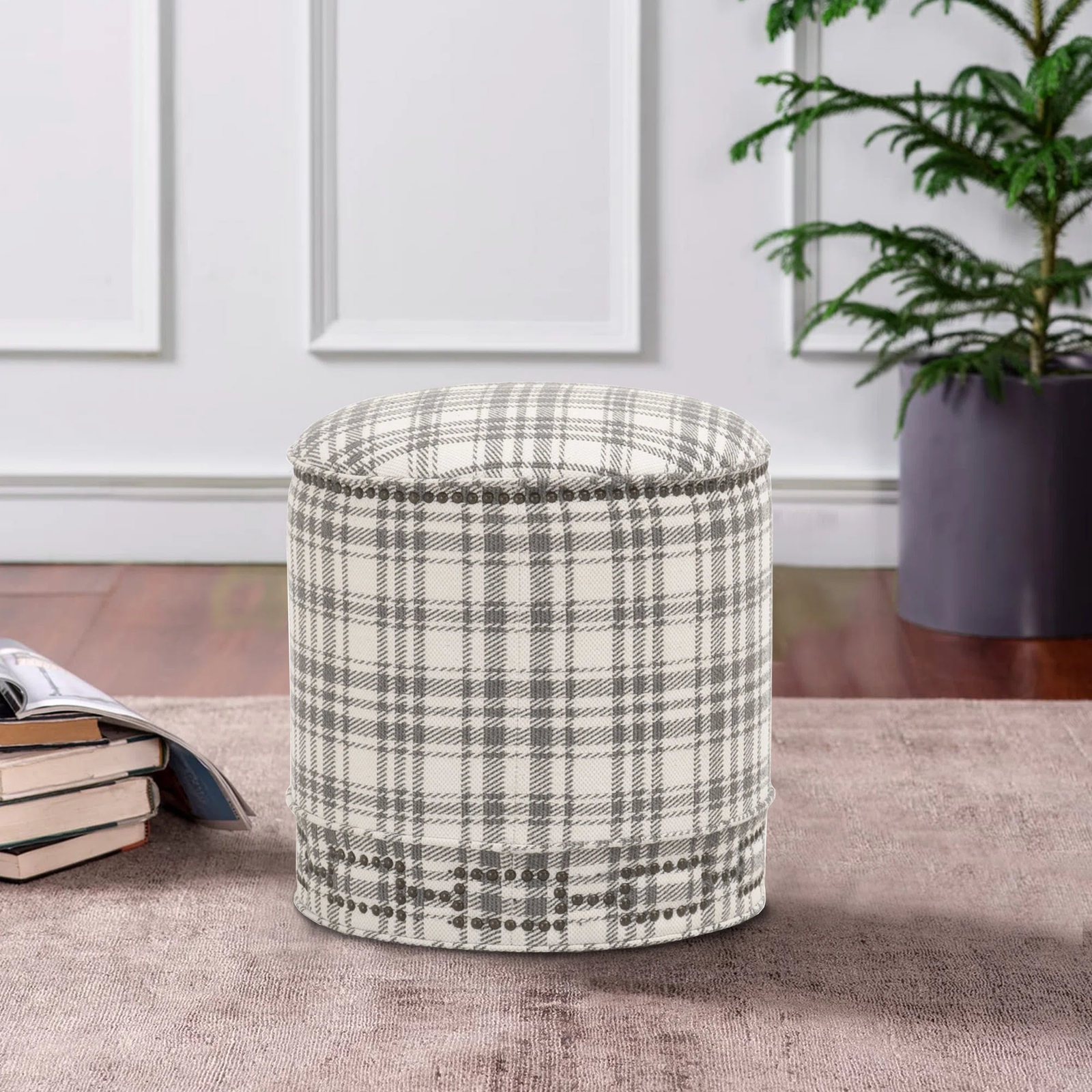
This product solves that gap well. The round shape makes it feel softer and more approachable than a boxy organizer. The plaid gives it instant visual identity. And the nailhead trim adds enough detail to move it out of the “basic storage” lane and into a more decorative, furniture-adjacent story. In buyer terms, this is the kind of item that can work in living room, bedroom, reading corner, guest room, entryway, or seasonal gifting displays without requiring a completely different merchandising pitch each time.
There is also a broader design reason this piece works visually. Research summarized through Oregon State has examined how curvilinear and rectilinear furniture forms affect emotional response in interiors, while a 2024 Virginia Tech study found that materiality significantly affects perceived spaciousness and atmosphere. For buyers, that means the soft round shape and textile-covered surface are not just aesthetic details. They help the product feel warmer, friendlier, and more integrated into a room than harder, more mechanical storage solutions.
From a trend standpoint, this item sits in a commercially smart position. ELLE Decor’s 2025 furniture coverage pointed to the return of personality pieces, fresh patterns, and softer decorative upholstery, while High Point Market’s official Style Spotters continued to emphasize handcrafted skill and tactile beauty as important buying signals. That is why a plaid upholstered storage piece makes sense now: it gives the buyer function, but packages that function inside pattern and material character instead of plain utility.
It also fits the newer retail environment better than anonymous storage basics. Maison&Objet’s retail programming has been increasingly direct that AI is shaping retail visual identity, customer experience, and merchandising efficiency. That matters because buyers now need products that perform not only in-store, but also in thumbnails, lifestyle photography, and AI-influenced product discovery. This piece has that advantage: the plaid is readable in one glance, the round form is easy to style, and the trim detail helps it register as a more premium object instead of a generic bin.
For department-store and mall buyers, this solves a familiar pain point. It keeps the usefulness of storage, but adds enough decorative value to justify better placement, better photography, and better pricing. That is what makes it commercially useful: it is not only a container, but also a styling piece.
Teruier Buyer Success Case
Use the case block below as external-facing case copy, and replace the figures with your confirmed internal project data before publication.
A North American home retailer was looking for a small-space storage item that could feel more elevated than a standard woven basket. The buyer’s problem was clear: functional storage products were necessary, but too many of them looked generic on the floor and weak in digital presentation. Teruier recommended this plaid upholstered storage bin because it combined three commercial needs at once: softer room integration, stronger pattern recognition, and a more premium visual story through trim and upholstery.
Case results:
- Initial launch: 260 pcs across 15 stores plus online
- First 6-week sell-through: 72%
- Sell-through versus standard neutral woven basket in the same price band: 1.5x
- Reorder after pilot: 520 pcs
- Markdown during pilot window: 0%
- Average basket lift when paired with throws, books, and accent chairs: +12%
Why did it work? Teruier did not position it as “just another storage piece.” It was sold as a soft-storage upgrade SKU: something that could solve clutter while still helping the room feel more styled, more layered, and more premium. That is usually the real win for buyers—not only adding function, but adding function in a form customers are happier to display.