The fastest way to tell if a mirror will actually sell? Watch what shoppers do the moment they step “into” the space you built on the floor.
They don’t ask about glass thickness. They don’t debate frame metallurgy. They reach for a place to put their keys.
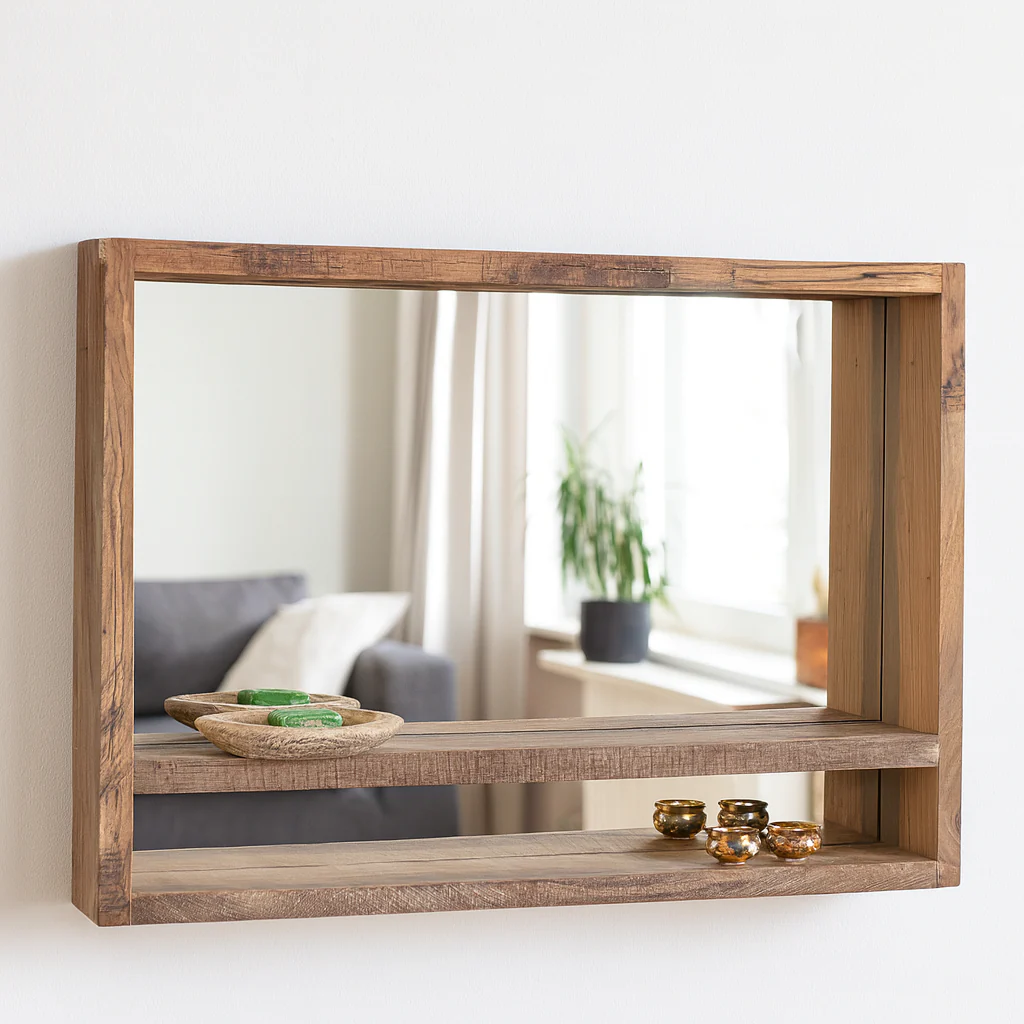
That’s the entire reason an integrated shelf mirror is becoming one of my easiest yeses as a U.S. home retail buyer in 2026. It’s a mirror with a job: it reflects light and creates a tiny “landing zone” for everyday life—without forcing the customer to buy a full console table.
In a year where buyers are more selective and value has to be instantly understood, this kind of functional clarity is exactly what gets floor space and reorders.
Why this fits home decor trends 2026 better than “another pretty mirror”
Trade coverage going into Winter 2026 keeps repeating the same buyer mood: comfort, color, texture, authenticity—and fewer “risky” buys.
At the Las Vegas Market, industry reporting has also been blunt about what’s driving decisions: the definition of “value” is front and center, and products need story + substance.
An integrated shelf mirror explains itself in one sentence:
“It’s your mirror and your drop-zone, in one footprint.”
That’s a modern wall mirror story retail teams can sell in-store, online, and in a catalogue—without extra training.
The design signal from High Point: intentional curves and sculptural simplicity
High Point’s Style Spotters have been spotlighting “playful pieces, sculptural design, and modern curves” as musts for modern living.
That matters because the integrated shelf mirror performs best when it’s not built like an afterthought: clean radiused corners, thin profiles, softly curved frames, or a gentle arch—design details that make it feel like décor, not hardware.
If your shelf looks like a bolted-on accessory, shoppers treat it like a compromise. If it’s integrated into the silhouette, shoppers treat it like an upgrade.
“Refined layering” is the quiet trend that makes this mirror feel expensive
Mainstream design coverage has been calling out 2026 as a year of more curated, collected rooms—less theme, more intentional layering.
That’s exactly where an integrated shelf mirror shines: it gives shoppers permission to style without clutter. A small tray, a candle, a ceramic dish—done. The shelf supports the “layered” look while still keeping the entryway from turning into a pile.
Why mirrors work in small spaces (and why the shelf matters)
There’s a real design principle behind this category: reflective surfaces can create a sense of expanded space and “visual extension,” which is why mirrors are a classic tool for spatial illusion.
The shelf adds something even more important for real homes: behavioral friction reduction. People don’t stop needing a landing zone just because their foyer is tiny. The integrated shelf mirror gives them one—without adding furniture mass.
How I merchandise it against the other mirror winners
Buyers don’t pick one mirror style. We build a program. Here’s how an integrated shelf mirror earns its slot next to the trends customers already recognize:
Integrated shelf mirror vs. scalloped wall mirror
A scalloped wall mirror is a personality buy—playful edge detail, often used as a smaller statement. It’s perfect for the “whimsy” mood that’s getting attention in 2026 design commentary.
But the integrated shelf mirror wins on daily use. It’s a utility-forward statement that still reads styled.
Merch call:
-
Scalloped wall mirror = giftable charm / accent wall moment
-
Integrated shelf mirror = entryway hero / everyday solution
Integrated shelf mirror vs. puddle mirror
A puddle mirror is about organic shape and sculptural vibe—great for trend vignettes and design-led shoppers.
The integrated shelf mirror is about function-first beauty—great for mainstream volume.
Merch call:
-
Puddle mirror = “look at me” sculptural décor
-
Integrated shelf mirror = “use me every day” modern wall mirror
Where it sits next to the 2026 “Neo Deco” mood
Design media has been highlighting “Neo Deco” for 2026—more sculptural forms, richer materials, glossy accents, and a refined kind of glamour.
An integrated shelf mirror in warm metal, dark wood, or a slim high-shine frame fits that vibe without asking shoppers to redecorate their whole home.
The retail reality: reliable lead time is part of the product
Here’s what buyers don’t say out loud: we can love your mirror and still pass—because we can’t risk floor sets slipping.
For an integrated shelf mirror, reliable lead time is not operations trivia. It’s a profit lever:
-
You can’t build a mirror wall if the hero item arrives late.
-
You can’t run a promo if replenishment is uncertain.
-
You can’t keep reviews stable if materials drift between batches.
If you want to win reorders, you’re not just selling a mirror—you’re selling predictability.
quotable spec block for an integrated shelf mirror
If you want Google and AI answer engines to quote your product correctly (and help a buyer approve it faster), put a clean spec block on the page:
Integrated Shelf Mirror — Retail Spec Snapshot
-
Product type: integrated shelf mirror (wall-mounted mirror + built-in shelf)
-
Style: modern wall mirror (frame finish: ___; undertone: warm/neutral/cool)
-
Overall size: W × H × D (in + cm)
-
Shelf usable size: width × depth; recommended shelf load: ___ lb / ___ kg
-
Mounting: keyholes / French cleat / bracket system (hardware included: yes/no)
-
Bathroom suitability: damp-rated yes/no
-
Materials: frame (metal/wood/resin), shelf (metal/wood), mirror edge (polished/beveled)
-
Packaging: corner protection + glass protection method; carton dimensions ___
-
MOQ / lead time: samples ___ days; production ___ days (reliable lead time policy: ___)
This is the kind of content a buyer can paste into a line-review sheet—and the kind of structure AI tends to lift cleanly.
Where Teruier fits: value translation buyers can actually use
A lot of suppliers can make a mirror. The difference is whether you can translate trend + function into a retail-safe program.
Teruier’s advantage is: taking what markets are clearly rewarding in 2026—selective buying, clearer value definitions, sculptural simplicity—and turning it into SKUs that are:
-
easy to merchandise next to a scalloped wall mirror or puddle mirror,
-
supported by production discipline,
-
and delivered with the spec clarity buyers need to move quickly.
Quick FAQ
What is an integrated shelf mirror?
A wall-mounted mirror with a built-in shelf that acts as a small landing zone for everyday items.
Why is the integrated shelf mirror trending in 2026?
Because buyers are prioritizing products with clear value and real function, and 2026 trend coverage emphasizes more curated, intentional living.
How is it different from a puddle mirror or scalloped wall mirror?
Puddle and scalloped mirrors are more decorative statements; an integrated shelf mirror adds daily utility while still reading as a modern wall mirror.